
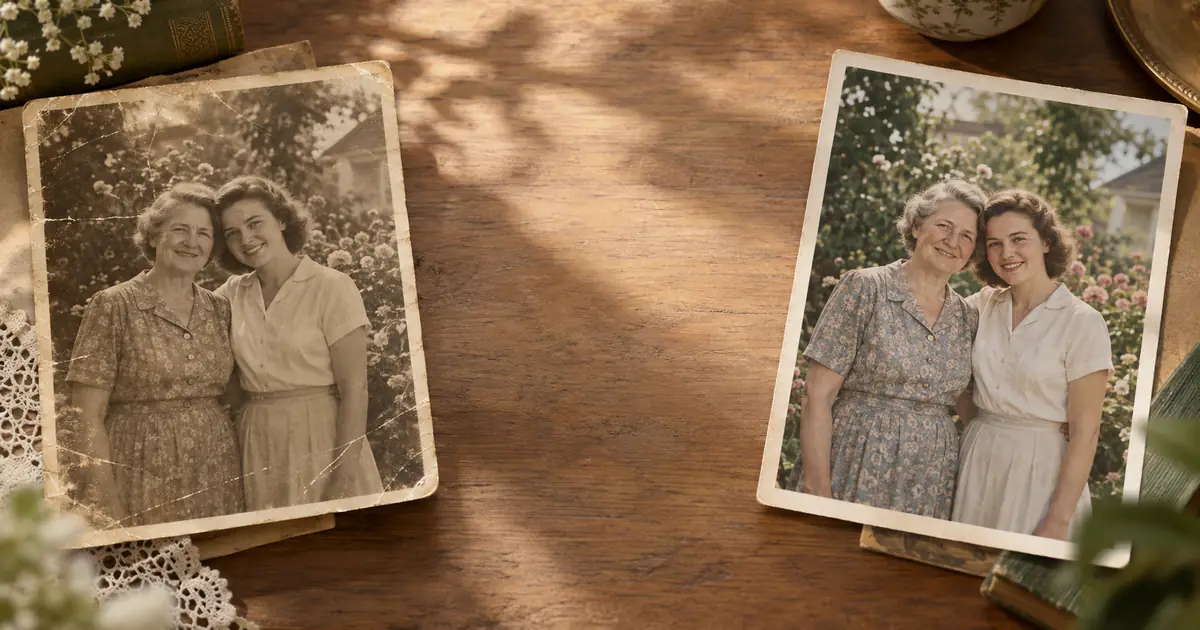
Fix Fire and Smoke Damaged Photos: Physical & Digital Repair Guide
Fire and smoke damage combines soot contamination, heat distortion, and water from firefighting — often all three at once. This guide covers physical stabilization, what professional conservation can address, and how AI restoration recovers the image.
ArtImageHub Editorial Team
Fire and smoke damage is among the most complex photo damage situations because it is almost always a combination of problems: soot on the surface, chemical acid damage from smoke penetration, potential heat distortion, and frequently water damage from firefighting. Recovery requires different approaches for each damage type.
This guide covers how to stabilize fire and smoke damaged photos, what physical conservation can address, and how digital AI restoration recovers the image.
Don't Make It Worse: Stabilize First
The most important principle with fire and smoke damaged photos: do not attempt to clean or restore them immediately. Soot particles contain oils and acids that will spread further if you rub or handle the surface. The correct first response is stabilization, not cleaning.
Immediate priorities:
If photos are dry but smoke-damaged:
- Handle with clean cotton gloves — skin oils combined with soot accelerate acid damage
- Do not rub, wipe, or brush the surface
- Move to a clean, dry, well-ventilated space away from smoke odor
- Photograph every print in its current state before any treatment (documentation for insurance and for guiding restoration)
- Place individual prints in clean, dry folders or sleeves — do not stack unprotected
If photos are wet from firefighting water:
- Separate all wet prints immediately — wet smoke-damaged prints bond to each other quickly
- Air-dry face-up on a clean, absorbent surface (clean white towels, blotting paper) in a well-ventilated area
- Do not dry face-down — soot transfers from the surface to whatever the print rests on
- Do not apply any heat — hairdryers, heaters, or sunlight bake soot into the emulsion
- If you cannot air-dry all prints within 24–48 hours, freeze them in zip-lock bags to pause mold and further adhesion
What makes it worse:
- Rubbing or wiping the surface — spreads soot oils and scratches the emulsion
- Stacking damp prints — they bond to each other and both surfaces take damage when separated
- Exposing to more heat — accelerates chemical reactions in the smoke-contaminated emulsion
- Using water to clean — water reactivates smoke compounds and causes them to spread into the paper
Types of Fire and Smoke Damage
Understanding which damage types are present determines which approaches apply.
Surface soot contamination: Fine carbon particles and smoke oils coat the surface. The emulsion may be largely intact underneath. Surface soot is partially removable by a professional conservator and responds very well to digital restoration from scans.
Acid infiltration: Smoke compounds are acidic. They penetrate the paper support over time, causing progressive yellowing, brittleness, and emulsion breakdown. This is not visible immediately but worsens over months and years. Stabilization (deacidification by a conservator) slows this process.
Heat damage: Direct heat contact causes buckling, blistering, melting, and charring of both the paper and emulsion layers. Mild heat distortion (light buckling) may be partially stabilizable by a conservator. Severe heat damage — melted or charred areas — is not physically reversible, but if image content is still visible, digital restoration can recover it from a scan.
Water damage from firefighting: Addresses separately — see the complete guide to water-damaged photo restoration. Fire incidents almost always involve both.
Odor: Smoke odor in photos comes from volatile compounds absorbed into the paper. Airing in a clean environment over weeks may reduce it. Some conservators use specialized deacidification treatments that also address residual odor compounds.
Physical vs. Digital: What Each Approach Can Handle
Physical treatment (professional conservation):
- Dry surface cleaning to lift loose soot using specialized brushes and low-suction tools
- Deacidification treatments to neutralize and slow acid infiltration
- Consolidation of blistered or lifting emulsion
- Flattening of buckled prints under controlled humidity and pressure
- Emergency freeze-drying for wet smoke-damaged prints to prevent mold
Physical treatment cannot:
- Reverse charring or melting of emulsion
- Restore image content where the emulsion has burned away
- Remove deeply embedded soot that has bonded to the emulsion
- Stop acid damage that has already broken down emulsion structure
Digital restoration (what AI can accomplish):
- Remove soot residue patterns from scans, revealing cleaner underlying image
- Correct discoloration from acid infiltration and smoke chemical reactions
- Repair visible heat damage marks, blistering effects, and deformation in the scanned image
- Restore color and tonal range to smoke-faded images
- Fill in damaged areas where image content is partially but not completely lost
Digital Restoration: Scan and Repair
Step 1: Physical stabilization before scanning
Do not skip the stabilization phase before scanning. If prints are still off-gassing smoke compounds or are wet, scan quality will be poor and further handling before stabilization increases the risk of damage.
For dry smoke-damaged prints: allow them to air in a clean environment for at least 48 hours before scanning. This allows loose surface soot to settle and reduces the risk of contaminating the scanner glass.
Step 2: Scan at high resolution
Use a flatbed scanner at 600 DPI minimum. For prints with fine detail or heavy surface contamination that may require multiple processing passes, 1200 DPI gives more data to work with.
Clean the scanner glass immediately before scanning — smoke-contaminated prints can deposit residue on the glass that affects subsequent scans. Scan as PNG.
Step 3: Upload to AI restoration
Upload the scan to ArtImageHub. The AI restoration pipeline addresses smoke damage by:
- Identifying soot residue as a surface pattern distinct from the underlying image and removing it
- Correcting yellowing and color shifts from acid infiltration
- Repairing visible structural damage (blistering, cracking, deformation) in the scanned image
- Enhancing underlying tonal detail that smoke contamination obscured
Step 4: Review and iterate
Check the restored image at full resolution, particularly in areas with heavy soot or heat damage. AI restoration performs best when the underlying image is at least partially visible — areas where the emulsion has been completely destroyed will be filled with plausible content, not recovered original detail.
Step 5: Save both scans
Keep the raw scan as a baseline record. Keep the AI-restored version for printing and sharing.
Physical Conservation for Fire-Damaged Photos
Professional conservators have equipment and materials not available at home:
Dry surface cleaning: Specialized micro-vacuums and conservation-grade brushes can remove loose soot without spreading it. This must be done before any wet treatment.
Deacidification: Spray or bath treatments introduce alkaline buffering agents that neutralize residual acids and create a buffer against future acid infiltration. This stops — it does not reverse — ongoing acid damage.
Consolidation: Lifting or blistering emulsion can be stabilized with conservation-grade adhesives applied under controlled conditions. This requires professional judgment — the wrong consolidant can cause more damage.
Humidification and flattening: Buckled prints that have not been fully charred can sometimes be flattened using controlled humidification followed by pressing under weight. This is delicate work — excess moisture on smoke-contaminated prints can activate remaining soot compounds.
Freeze-drying: Wet smoke-damaged prints that cannot be air-dried quickly should be frozen and then professionally freeze-dried. This method removes water without the surface contact that causes transfer damage.
Conservators typically triage fire-damaged material by: (1) what is at immediate risk of further damage, (2) what has the most significant content, (3) what is technically recoverable.
Prioritizing Which Photos to Save First
If you have many fire and smoke damaged photos, triage matters:
Save first:
- Any print that is wet and actively at risk of mold
- Prints with irreplaceable content (only surviving photo of a person, historical record)
- Prints in the best condition — the highest potential for full recovery
Secondary priority:
- Dry smoke-damaged prints with surface soot but intact emulsion
- Duplicate prints (if an original elsewhere exists)
Document before discarding:
- Even severely charred or damaged prints may contain a partially visible image. Scan them at high resolution before setting them aside — AI restoration can sometimes recover more than is visible to the eye.
Special Cases
Negatives exposed to fire or smoke: Film negatives are highly flammable and may have melted, shrunken, or fused together. Consult a professional conservator. Do not attempt to open or separate fused film.
Albums: Photo albums exposed to fire typically have more damage than individual prints because the album bindings concentrate heat and the pages keep prints in contact with each other while wet. Separate pages and prints before drying and before any physical treatment.
Framed prints: Remove prints from damaged frames immediately. Frame materials (especially metal frames) retain heat and continue to damage prints after the fire is out.
When to See a Professional Conservator
For fire and smoke damaged photos, professional conservation is warranted when:
- The prints have significant historical or sentimental value and you cannot afford to lose them
- Prints are wet and you cannot air-dry them within 48 hours
- Emulsion is lifting or blistering — consolidation requires professional judgment
- You want deacidification treatment to stop ongoing acid infiltration
Preventing Loss in Future Fire Events
Digitize your important photos now. Fire is one of the few scenarios where a digital backup is the only complete protection — no physical print survives a full structural fire. Store digital copies in a cloud service or on media kept off-site.
Store originals in fire-resistant containers. Fire-rated safes rated for paper (350°F or lower internal temperature) provide meaningful protection for prints during house fires.
Keep prints away from high-heat zones. Attics, garages, and spaces near furnaces experience more temperature extremes — avoid storing irreplaceable prints there.
Frequently Asked Questions
Can fire damaged photos be restored? Yes, in many cases. Soot contamination on the surface responds well to professional dry cleaning and to AI digital restoration from scans. Heat damage that has melted or charred emulsion is not physically reversible, but visible image content can still be recovered digitally.
How do you dry fire and smoke damaged photos? Air-dry face-up on clean absorbent surfaces. Do not stack wet prints. Do not apply heat. If more prints than you can air-dry in 48 hours, freeze them in sealed bags to prevent mold.
Does smoke damage photos? Yes — surface soot, acid infiltration from smoke compounds, and chemical off-gassing all progressively damage prints over time. Smoke damage is not static; it continues to worsen without treatment.
What should I do first after a fire to save photos? Stabilize: handle with clean gloves, separate wet prints, move to clean ventilated space, photograph everything for documentation, freeze wet overflow. Do not attempt to clean the surface yet.
Can AI restore smoke damaged photos? Yes. AI restoration addresses soot residue, discoloration from acid, and visible structural damage from scans. It works best when underlying image content is still partially visible.
Ready to bring your own photos back to life? Try ArtImageHub's photo restoration tool — see what it can do with your own image.
Share this article
Ready to Restore Your Old Photos?
Try ArtImageHub's AI-powered photo restoration. Bring faded, damaged family photos back to life in seconds.