
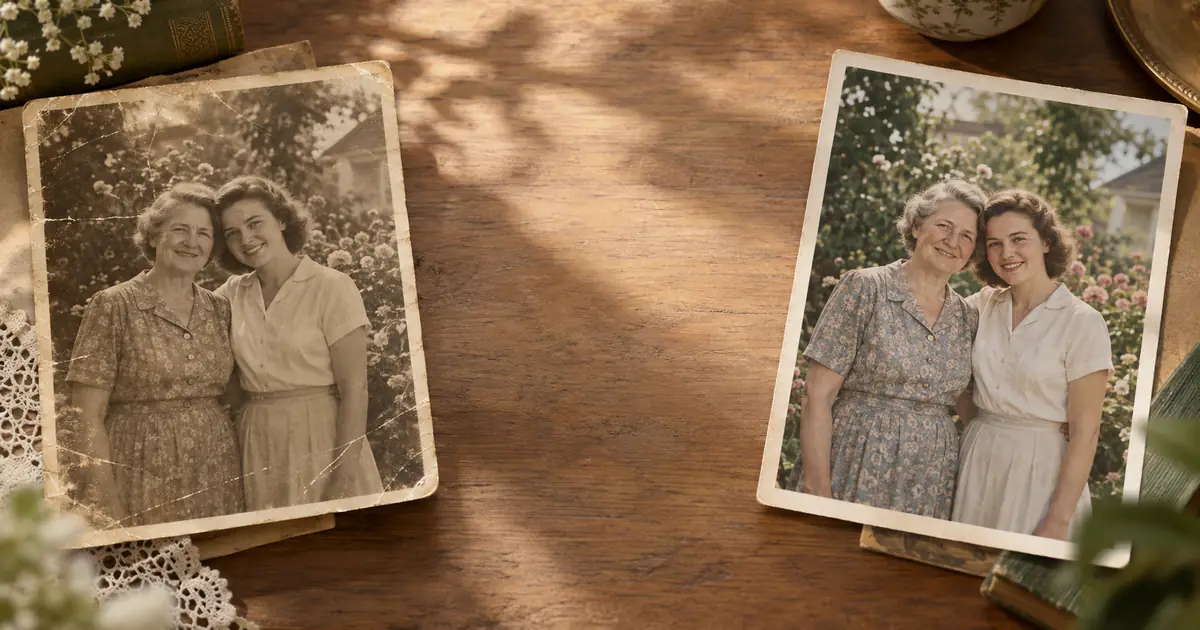
Remove Foxing from Old Photos: Physical & Digital Guide
Foxing — the reddish-brown spots on aged photographs — cannot be removed at home without risking the print. This guide explains what foxing is, what professional conservation can do, and how AI digital restoration removes foxing from scanned images.
ArtImageHub Editorial Team
Foxing is one of the most common deterioration patterns in old photographs. The reddish-brown spots — ranging from tiny pinpoints to clusters covering larger areas — are a reliable sign of long-term storage in suboptimal conditions. Understanding what foxing is, what can and cannot be done about it, and how to recover the image digitally gives you a clear path for affected photographs.
Foxing is one of several stain types that affect old photographs. For a comprehensive guide covering water stains, adhesive residue, oil, insect damage, and other forms of surface contamination alongside foxing, see removing stains from old photographs.
What Foxing Is and Where It Comes From
The term comes from the reddish-orange color of a fox's coat, which matches the typical spot color. Foxing appears on photographs, books, maps, and other paper-based materials — any item with a paper support stored in warm, humid conditions over time.
The chemistry: The most accepted explanation involves metal impurities — iron, copper, and manganese compounds — that are present in virtually all papers. When these compounds are exposed to humidity and oxygen over long periods, they undergo oxidation reactions that produce pigmented compounds. The reddish-brown color is characteristic of iron oxidation products.
The fungal factor: Some researchers have found fungal material in foxing spots, suggesting that mold spores already present in the paper can amplify or co-produce the staining pattern. The relationship between the chemical and fungal pathways is still studied, but both appear to contribute in different environmental conditions.
Why some photographs fox more than others: The severity depends on the original paper quality (higher metal impurity content = more foxing potential), storage conditions (humidity is the most important variable), and the photographic process used (gelatin silver prints from certain eras and manufacturers have more susceptibility than others).
What Foxing Looks Like
Foxing appears as:
- Small to medium spots, typically 1–10mm in diameter, though sometimes larger
- Color ranging from light tan to deep reddish-brown or rust-orange
- Irregular edges — not perfectly round
- Often scattered, sometimes clustered in areas of the print that were exposed to more moisture
- Flat surface — not raised or textured like active mold
- Sometimes present on the back of the print as well as the front
Foxing differs from water staining (which creates tide marks and gradients rather than discrete spots) and from physical damage like scratches or tears.
Don't Make It Worse: What Not to Do
Common home remedies for foxing reliably make the situation worse:
Bleach solutions: Household bleach is highly concentrated relative to the dilute conservation bleaches used professionally. It will lighten the image layer along with the foxing spots and cause chemical damage to the gelatin.
Lemon juice or vinegar: These acids can react with the paper and emulsion to cause yellowing and brittleness.
Rubbing or polishing: Physical abrasion spreads the oxidation compounds and scratches the emulsion surface.
Sunlight exposure: UV light bleaches photographic images and can cause uneven fading.
Any wet treatment at home: Water causes the gelatin to swell unevenly and can spread the oxidation compounds. Professional conservation uses controlled aqueous treatments at specific concentrations and pH levels.
The safest home action: scan the photo and let digital restoration address the foxing in the digital image.
Physical Treatment: What Professional Conservation Can Do
Professional conservators can treat foxing on appropriate print types using aqueous bleaching:
How it works: The print is floated or treated with a dilute bleaching solution — typically calcium hypochlorite, sodium borohydride, or chloramine-T, depending on the print type and foxing severity. The solution is formulated and buffered to target the oxidation compounds while limiting interaction with the image layer.
What it requires:
- Correct identification of the photographic process — aqueous bleaching is suitable for gelatin silver prints but inappropriate for albumen prints, color prints, and most pre-1900 photo types
- Professional judgment about solution concentration and contact time
- Neutralization and stabilization treatments after bleaching
- Experience with this specific technique, which not all conservators practice
Realistic outcomes: Moderate foxing can often be significantly reduced. Severe foxing — particularly in dense clusters — may be partially improved. The treatment does not guarantee complete removal, and there is always risk of some effect on the image layer.
Cost and availability: Aqueous bleaching treatment is typically expensive (conservators often quote by the hour, with complex treatments taking several hours), and not all conservators offer it. For most family photographs, this cost is not justified when digital restoration is available.
Digital Restoration: The Practical Path for Most Photos
For family photographs with foxing, digital restoration is faster, lower-risk, and more affordable than physical conservation. The process is straightforward:
Step 1: Scan at high resolution
Use a flatbed scanner at 600 DPI for standard prints. For photos with dense foxing or small spots, 1200 DPI gives the AI restoration model more data to work with and produces cleaner results on fine detail.
Scan as PNG. Clean the scanner glass before each scan to prevent dust from appearing as additional spots.
Step 2: Upload to AI restoration
Upload the scan to ArtImageHub. Foxing spots are among the damage types AI restoration handles very reliably:
- Spots are small and localized — the AI has intact image context on all sides of each spot
- Foxing patterns are characteristic enough that the AI identifies them consistently as damage
- The underlying image content beneath foxing spots is typically intact — the spots are above the image, not replacing it
The AI removes the spots and reconstructs the original tone and texture underneath from the surrounding image data.
Step 3: Review the result
Check at full resolution for any spots that may have been missed or where the reconstruction looks slightly different from surrounding areas. Dense clusters on complex image content (fine textile patterns, detailed architectural elements) are worth reviewing closely.
Step 4: Save the restored version
Keep the original scan as a reference. The AI-restored version is the working file for printing and sharing.
Severity and Expectations
Mild foxing (scattered spots, few dozen): AI restoration typically removes these cleanly in a single pass. The result is very close to the original undamaged print.
Moderate foxing (many spots, some clusters): AI restoration handles this well. Dense clusters may show minor reconstruction variation, but the result is significantly improved.
Severe foxing (large portions of the image covered): AI restoration will improve the image substantially. In very severe cases, reconstruction in heavily foxed areas may not perfectly match the original, but the result is still far more usable than the damaged original.
Foxing over faces or fine detail: The AI handles this well because it draws on the full context of the face or detail to reconstruct what the foxing was covering.
Foxing and Storage: Slowing the Progression
If you want to preserve the physical print alongside the digital restoration, controlling the environment is the most important step.
Temperature and humidity: Store photographs at 65°F (18°C) or below, with relative humidity between 35–45%. This is museum standard. For home storage, a climate-controlled room consistently below 70°F and below 50% RH is a significant improvement over an attic or garage.
Archival enclosures: Use acid-free polyester, polypropylene, or polyethylene sleeves. Avoid PVC (vinyl) sleeves — they off-gas compounds that accelerate paper degradation. Acid-free folders and boxes buffer against environmental fluctuations.
Separation from acidic materials: Newsprint, cardboard, non-archival albums, and wood products off-gas acids that accelerate foxing and other deterioration. Store photographs separately from these materials.
Inspect periodically: Check photographs in storage every few years. Catching early-stage foxing when conditions are still reversible is easier than addressing widespread damage later.
Identifying Print Type Before Treatment
If you are considering professional conservation (rather than digital restoration), identifying your print type is essential — the treatment approaches differ significantly.
Gelatin silver prints (most 20th-century family photos): Matte to glossy surface, printed on paper with a gelatin coating. Most responsive to aqueous bleaching for foxing.
Albumen prints (ca. 1850–1900): Slightly warm, slightly shiny surface. Fragile, requires gentle treatment. Aqueous bleaching is riskier.
Cyanotype ("blueprint" process): Blue-tinted image. Extremely sensitive to water and bleaching agents. Consult a specialist conservator.
Color prints (chromogenic, after ca. 1940): Different dye structure. Aqueous bleaching appropriate for black-and-white gelatin prints is inappropriate here. Digital restoration is the primary practical option.
If you are uncertain of the print type, a conservator can identify it. For most family photograph foxing projects, digital restoration is the appropriate starting point regardless of print type.
When to See a Professional Conservator
Professional treatment is warranted when:
- The print has monetary value (photography collections, fine art prints)
- The print is a historically significant object in addition to containing an image
- Foxing is spreading rapidly and the print will be significantly degraded without intervention
- The print type requires specialized knowledge (daguerreotypes, ambrotypes, cyanotypes)
Frequently Asked Questions
What is foxing on photographs? Reddish-brown or tan spots caused by chemical oxidation of metal impurities in paper, often combined with fungal activity. Very common on photographs stored for decades in humid conditions.
Can foxing be removed from photographs? Professionally, yes — conservators use controlled aqueous bleaching on appropriate print types. At home, no safe method exists. Digitally, AI restoration removes foxing spots from scanned images very effectively.
Does foxing spread on photos? Yes, in humid storage conditions. Reducing relative humidity below 50% slows or stops progression.
How do you prevent foxing on photographs? Store below 50% relative humidity in acid-free enclosures, away from attics, basements, and acidic materials.
Is foxing the same as mold? Related but not identical. Active mold has raised texture and odor. Dry foxing spots are flat chemical stains that look similar to mold damage and respond similarly to digital restoration.
Ready to bring your own photos back to life? Try ArtImageHub's photo restoration tool — see what it can do with your own image.
Share this article
Ready to Restore Your Old Photos?
Try ArtImageHub's AI-powered photo restoration. Bring faded, damaged family photos back to life in seconds.