
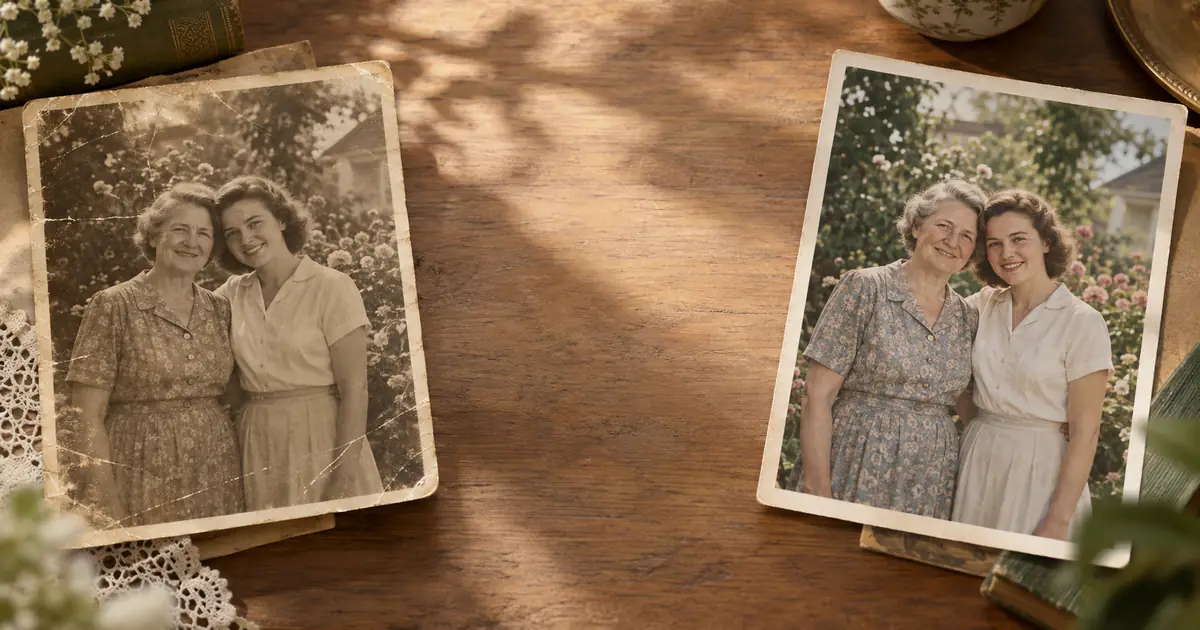
Fix Cracked and Creased Photos: Physical & Digital Repair Guide
Cracks and creases in old photos range from reversible surface folds to permanent emulsion loss. This guide covers what physical flattening can and can't fix, and how AI digital restoration handles what physical methods leave behind.
ArtImageHub Editorial Team
A cracked or creased photograph holds two separate problems: the damage to the physical print, and the visual damage to the image. Physical repair addresses the first; digital restoration addresses the second. For most cracked and creased family photos, recovering the image digitally is the goal — and AI restoration handles crack and crease lines among its most reliable repairs.
Don't Make It Worse: Immediate Assessment
Before deciding how to handle a cracked or creased photo, understand what you are looking at.
Surface creases (paper fold, emulsion intact): The photo was folded or bent, but the emulsion on the surface held. Under close examination, you see a crease or ridge in the photo surface but the image appears continuous across the fold. These can sometimes be physically improved.
Cracked emulsion (visible white or light lines in the image): The emulsion layer has fractured, exposing the paper backing beneath. The crack appears as a light-colored line within the image. This is permanent physical damage to the print that cannot be reversed.
Deep folds with multiple cracks: A photo that was folded sharply or stored folded for a long time may have a grid of crease lines, each accompanied by emulsion cracking along the fold. The print may feel brittle or inflexible along the fold lines.
What makes it worse:
- Unfolding or flattening a brittle photo too quickly — if the paper has become rigid from age, forcing it flat can crack both the support and the emulsion
- Rolling a flat photo to move it — introduces new curvature and stress
- Storing cracked photos with other photos face-to-face — loose emulsion chips can adhere to adjacent prints
The safest first step with any cracked or creased photo is to scan it before attempting any physical treatment.
Physical vs. Digital: What Each Can Accomplish
Physical repair (what humidification and flattening can do):
- Relax mild creases where the emulsion stayed intact
- Reduce paper curl or warping
- Stabilize the print to prevent further physical deterioration
- Flatten a photo enough to scan it more cleanly
Physical repair cannot:
- Fill in cracks in the emulsion
- Remove visible crack or crease lines from the image
- Restore image color or tone where emulsion has been lost
- Reverse brittleness caused by paper or emulsion aging
Digital restoration (what AI can accomplish):
- Remove crack and crease lines from the image, regardless of severity
- Fill in image content where the emulsion has cracked away
- Restore tone and color along damaged areas
- Produce a clean, printable version of the image that shows no evidence of the damage
For the image itself, digital restoration is consistently more effective than physical repair and much lower risk. Physical repair is worthwhile if the print is significant as an object and you want to stabilize it for long-term storage — but it is not necessary to achieve a clean digital image.
Digital Restoration: The Fastest Path to a Fixed Image
Step 1: Scan the photo before physical treatment
Scan the cracked or creased photo at 600–1200 DPI on a flatbed scanner. Place it face-down on the scanner glass. If the photo is too warped to lie flat, place it as flat as you can — the scanner's depth of focus accommodates a small amount of curvature.
For severely curled or rolled photos that cannot be scanned in one pass: scan the photo in two overlapping sections and combine them in any image editor (even basic software like Windows Photos or Preview on Mac allows cropping and arranging). Imperfect scans with some distortion are still workable for AI restoration — get the image data captured before anything else.
Step 2: Upload to AI restoration
Upload the scan to ArtImageHub. Crack and crease lines in photos are linear damage patterns — similar to deep scratches — that AI restoration handles reliably. The AI identifies the crack lines as damage (not image content), fills them in from the surrounding pixels, and restores tone and contrast along the repaired areas.
Step 3: Review the result
The AI restoration output for a cracked photo typically removes crack lines cleanly across continuous backgrounds, textured surfaces, and even across facial features and clothing. For photos where the emulsion has crumbled away in large areas (not just lines but patches), the AI reconstructs from context and may introduce some approximation in the reconstructed areas — compare the restored version with the original scan to identify areas that may need a second look.
Step 4: Save both versions
Keep the original high-resolution scan for your records. Use the AI-restored version for printing, sharing, and display.
What AI restoration handles well with cracks and creases
Handles well:
- Straight or gently curved crack lines across any background type
- Crease patterns from folded photos, including grid patterns from multiple folds
- Crack lines across faces, sky, water, and complex backgrounds
- Photos with many fine cracks (heavily crazed emulsion)
More difficult:
- Large areas where emulsion has flaked away completely (significant missing patches rather than lines)
- Photos so severely cracked that no clear image information remains in large zones
Physical Repair: Humidification and Flattening
If you want to physically treat the print after scanning — for archival stability or to improve the surface condition — careful humidification and pressing is the standard approach.
When it's appropriate: Only attempt physical relaxation of creases on prints that are not brittle. If the photo feels stiff or has emulsion that looks like it might flake, physical treatment risks further damage. When in doubt, conserve effort for digital recovery and consult a professional for the physical object.
Basic humidification approach:
- Place the photo face-up in a loosely sealed plastic container with a damp (not wet) sponge or paper towel positioned so it does not touch the photo. The goal is to raise the humidity around the photo, not to wet it.
- Check after 15–30 minutes. The paper should feel slightly more flexible but not damp to the touch.
- Remove the photo and place it face-up between two sheets of clean porous paper (blotting paper or acid-free tissue).
- Place this under a stack of flat heavy books. Leave overnight.
- Remove and allow to air-dry fully before storage.
This process can relax mild creases. Deep creases with cracked emulsion will still show crack lines in the emulsion even after flattening — the paper crease is reduced but the emulsion damage is unchanged.
Do not: Wet the photo directly, iron it, or use a heat press. Heat and direct moisture damage emulsion and dye layers.
Special Cases
Tintypes and daguerreotypes: These early metal-based photographs crack differently than paper prints. A cracked tintype has fractured metal that cannot be re-fused. Do not attempt humidification on these — it will cause oxidation. Scan as-is and let AI restoration handle the crack lines.
Photos folded and stored for decades: Very old, brittle paper may crack further when unfolded. If the photo is tightly rolled or folded and has not been opened in years, humidify it gently first (as described above) before attempting to unfold it. If it resists, scan it in its current folded state if possible and consult a conservator.
Rolled panoramic photos: Large panoramic prints rolled for storage develop curvature that is difficult to flatten. Scan in sections, or use a book scanner or overhead scanner if available. AI restoration works on stitched panoramic segments.
Photos with lifting or flaking emulsion: Where the emulsion has physically separated from the paper and is at risk of being lost, stabilize first by placing a thin sheet of clean tissue over the area and scanning with the tissue. Even with this covering, the AI can often work through the diffusion. Consult a conservator for adhesive consolidation of lifting emulsion before further handling.
When to See a Photo Conservator
Physical conservation makes sense for cracked or creased photos when:
- The print is historically significant (not just the image but the object itself)
- Emulsion is actively flaking and at risk of further loss
- Photos are stuck together at a fold or crease
- You want the physical print stabilized for long-term archival storage
Preventing Cracks and Creases
Store flat, not folded. Photos stored folded develop permanent crease damage over years. Store horizontally in archival boxes or vertically in slots with rigid dividers so they cannot fall and fold.
Acid-free enclosures. Acidic paper causes brittleness over time. Acid-free folders and boxes slow down the paper aging that makes emulsion susceptible to cracking.
Consistent temperature and humidity. Fluctuations cause paper to expand and contract repeatedly, which fatigues the material and eventually causes cracking. The same cool, dry, stable environment that prevents mold also prevents physical emulsion cracking.
Handle by edges, not surfaces. Fingerprints leave oils that degrade emulsion over time. Hold photos by their edges.
Frequently Asked Questions
Can cracked photos be repaired? Cracks in the emulsion cannot be physically reversed. Digital restoration removes crack lines from scans reliably. Scan first, then pursue any physical stabilization.
Can you flatten a creased old photo? Mild creases can be partially relaxed by humidification and pressing under weight. Deep creases with emulsion cracking will still show crack lines after flattening. Digital restoration is the reliable path to a clean image.
How do I scan a cracked or creased photo? Use a flatbed scanner at 600–1200 DPI. Place face-down and allow the weight to flatten the photo against the glass. Scan in sections for severely curled prints.
Does AI restoration remove crack lines from photos? Yes, very effectively. Crack and crease lines are among the damage types AI restoration handles most reliably.
What is the difference between a crease and a crack in a photograph? A crease is a fold in the paper that may not have broken the emulsion. A crack is a fracture in the emulsion layer itself, visible as light-colored lines in the image. Creases can sometimes be partially corrected; cracks in emulsion are permanent in the print but removable digitally.
Ready to bring your own photos back to life? Try ArtImageHub's photo restoration tool — see what it can do with your own image.
Share this article
Ready to Restore Your Old Photos?
Try ArtImageHub's AI-powered photo restoration. Bring faded, damaged family photos back to life in seconds.