
Why Do Old Photos Turn Yellow? The Chemistry Behind Photo Yellowing and How to Fix It
Old photos turn yellow because of silver oxidation, dye decay, and paper acid degradation — different causes require different fixes. Here's what's actually happening and what you can do about it.
ArtImageHub Editorial Team
Old photos turn yellow because photographs age — and the chemistry of how they age depends on exactly what kind of photograph you are looking at. A black-and-white print yellows for different reasons than a color snapshot, and both are different from the spotted brown foxing that appears on 19th-century prints.
Understanding what caused your specific photo to yellow tells you what you can realistically do about it.
What Is the Word for a Yellowed Photograph?
There is no single archival term for a yellowed photograph — different yellowing processes have different names.
For black-and-white prints, the most specific technical term is silver mirroring (also called mirroring out or silvering out): a reflective, metallic sheen with a warm yellow or blue tone that develops when silver ions migrate to the print's surface and oxidize. A more general term for brown or yellow discoloration in B&W prints is sulfiding — the silver image has reacted with sulfur compounds to form brownish silver sulfide.
For color prints, the process is described as dye fading or color shift. Color photographs contain three distinct dye layers, and when one or more dyes decay faster than the others, the remaining colors create an overall yellow or orange cast.
For the spotted, brownish discoloration that appears on paper prints, the archival term is foxing — distinct from overall yellowing, and more associated with early paper-based photographs (albumen prints, salted paper prints) and old documents.
In everyday language, a yellowed photograph is simply called a faded print or a yellowed print. None of these changes are physically reversible, but they are all correctable digitally.
Why Black-and-White Photos Turn Yellow
Black-and-white photographs are formed from metallic silver particles suspended in a gelatin emulsion coated on paper or glass. The silver is what forms the image — dense silver particles in shadow areas, sparse or no silver in highlights.
Over time, several chemical processes attack this silver image:
Sulfiding: Atmospheric sulfur compounds — from air pollution, cardboard boxes, certain papers, rubber bands, and even some paints — react with the silver image to form silver sulfide. Silver sulfide has a warm brown-yellow color. This is the same reaction that tarnishes silver jewelry. Humidity accelerates the process dramatically.
Oxidation: Oxygen in the air reacts with the silver image, converting metallic silver to silver oxide. This tends to produce more of a yellow-brown color in shadow areas.
Residual fixer: When black-and-white film and prints are processed in a darkroom, a chemical called fixer (sodium or ammonium thiosulfate) is used to remove unexposed silver halides. If the print is not washed thoroughly enough after fixing, residual fixer remains in the paper fibers. Over decades, this reacts with the silver image to cause yellowing and deterioration — the characteristic problem of old machine-processed prints.
Silver mirroring: In prints where the silver has migrated toward the surface, a reflective sheen appears that looks iridescent in raking light. This is more yellow in warm light and more blue in cool light. It is common in very old prints, poorly processed prints, and prints that have been stored with inadequate ventilation.
Why Color Photos Turn Yellow
Color photographs made before the 1990s were notoriously unstable. A color print is not made from silver — it is made from three layers of organic dyes (cyan, magenta, and yellow) that together create the full range of colors in the image.
The problem is that these three dyes do not fade at the same rate.
In most pre-1990s color print films (C-41 process): Cyan dye is typically the least stable and fades first. As cyan disappears from the image, the remaining magenta and yellow dyes create a warm, orange-yellow overall cast. This is why old color snapshots from the 1970s and 1980s frequently look orange or yellow even when the original scene had neutral colors.
In Kodachrome slides: Kodachrome has exceptional dye stability by historical standards — Kodachrome from the 1940s and 1950s often looks better than color print film from the 1980s. When it does yellow, it is usually in the blue shadows.
In Ektachrome and other E-6 slides: These dyes are less stable than Kodachrome. Cyan fading dominates, creating the characteristic red or orange cast in faded E-6 slides.
Heat and light are the primary accelerants: A color print stored in a hot attic can fade severely in a decade. A print in a cool, dark, dry environment can look nearly new after 40 years. Direct sunlight can fade a displayed print in months.
What Causes Foxing
Foxing — the reddish-brown or yellowish spots that appear on old paper photographs and documents — is a different process from overall yellowing. It affects the paper support more than the image layer and appears as irregular spots ranging from pinpoint to several millimeters across.
The exact cause of foxing is still debated, but two factors are consistently implicated:
Fungal growth: The spots in foxing often show evidence of fungal activity — spores or hyphae in microscopic analysis. High humidity creates conditions for fungal growth, which produces organic acids that discolor the paper.
Metal impurities in the paper: Iron and copper impurities in the paper act as catalysts for oxidative reactions that produce the characteristic reddish-brown color. Many early paper stocks contained significant metal contamination from manufacturing processes.
Foxing is common on 19th-century albumen prints (egg-white coating over paper), on salted paper prints, and on paper backing materials. It is much rarer in modern (post-1950) color prints, which use different paper stocks.
Types of Photos That Yellow the Fastest
Not all old photographs yellow at the same rate:
- Vernacular color prints from the 1970s–1980s: Fast-fading dyes and low-cost processing → severe yellowing common
- Machine-processed black-and-white prints (1940s–1960s): Often poorly fixed and washed → residual fixer causes yellowing
- Albumen prints (1850s–1900s): The albumen (egg white) coating yellows with age, often giving the image an overall warm tone
- Cyanotypes (blueprints): Fade to yellow in strong light, but are reversible if kept in the dark
- Daguerreotypes: Don't yellow per se, but develop a tarnish layer that obscures the image
Most stable for their era:
- Platinum/palladium prints: extremely stable
- Kodachrome slides: exceptional dye stability
- Modern inkjet or chromogenic prints (post-2000): much more stable dyes
Can Yellowed Photos Be Restored?
Physically: No. The chemical changes that cause yellowing — silver sulfide formation, dye decay, foxing — are irreversible in place. You cannot chemically restore a yellowed photograph to its original state without specialized laboratory conservation, and even then results are limited.
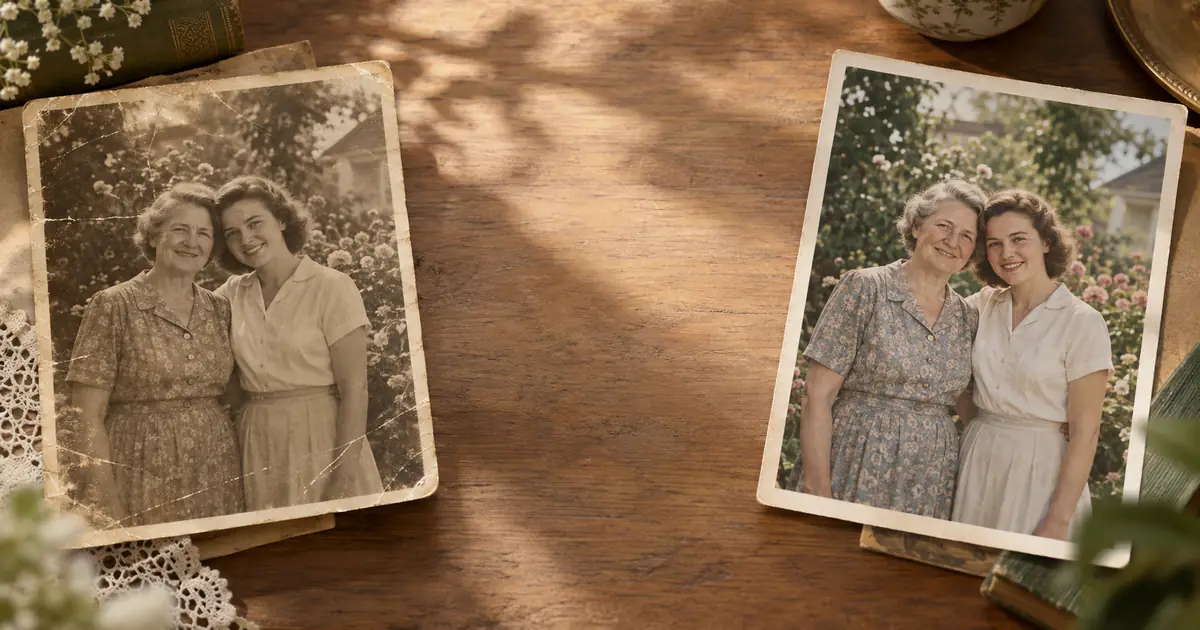
Digitally: Yes, very effectively. Scanning the photograph at high resolution and using AI restoration tools captures whatever image information remains and corrects the color shift digitally.
The process:
- Scan at 600–1200 DPI depending on print size
- Upload to an AI restoration tool (ArtImageHub is designed specifically for old photo damage including yellowing)
- The AI analyzes the color shift, identifies what neutral tones and skin tones should look like, and rebalances the image
- Download the corrected version
AI restoration works particularly well on:
- Overall yellow or orange color casts from dye fading
- Warm tones from silver sulfiding in B&W prints
- The general softness that comes with fading
It works less well on:
- Severe foxing (the spots are part of the image layer)
- Extreme photo loss where large areas have no remaining detail
- Silver mirroring (the reflective surface makes scanning difficult — use a flat scanner, not a phone camera)
How to Slow Down Yellowing in Photos You Still Have
If you have original prints you want to preserve:
Storage environment: Store prints in acid-free boxes or albums, in a cool (below 65°F), dry (below 50% relative humidity) location. Avoid attics and basements — both extremes of heat/humidity and temperature swings accelerate all aging processes.
Acid-free materials: Avoid rubber bands, non-archival plastic sleeves, and newspaper interleaving. All of these off-gas chemicals that accelerate yellowing.
Scan now: The most practical preservation step for most people is to scan prints at high resolution while they are in their best current condition. Even a yellowed print that is scanned today can be digitally restored, but a print that continues to deteriorate may lose more detail before you scan it.
Display vs. storage: Displaying originals in direct light causes rapid fading. If you want to display a family photo, display a high-quality print of the digitally restored version and store the original in archival conditions.
Frequently Asked Questions
What is the technical term for a photo that has yellowed? It depends on the process: silver mirroring or sulfiding for B&W prints, dye fading or color shift for color prints, and foxing for spotted brown discoloration on paper. In general conversation, "faded" or "yellowed" print covers all cases.
Why do old black-and-white photos turn yellow? The silver image reacts with atmospheric sulfur to form silver sulfide (brown-yellow color) and with oxygen to form silver oxide. Residual fixing chemicals also cause yellowing if prints were not washed thoroughly in processing.
Why do old color photos turn yellow or orange? The three dye layers (cyan, magenta, yellow) fade at different rates. Cyan typically fades first, leaving the remaining dyes — magenta and yellow — producing an orange or yellow overall cast.
Can foxing be removed from photographs? Physically, foxing removal requires delicate conservation treatment. Digitally, foxing spots can be corrected in a scan using AI restoration or manual retouching.
How can I tell if a photo is going to fade quickly? Color prints from the 1970s and 1980s (particularly snapshots processed at drug stores or quick labs) are the highest-risk. Kodachrome slides from the same era are the most stable. Any photograph stored in heat and humidity will yellow faster than one stored cool and dry.
Ready to bring your own photos back to life? Try ArtImageHub's photo restoration tool — see what it can do with your own image.
Share this article
Ready to Restore Your Old Photos?
Try ArtImageHub's AI-powered photo restoration. Bring faded, damaged family photos back to life in seconds.