
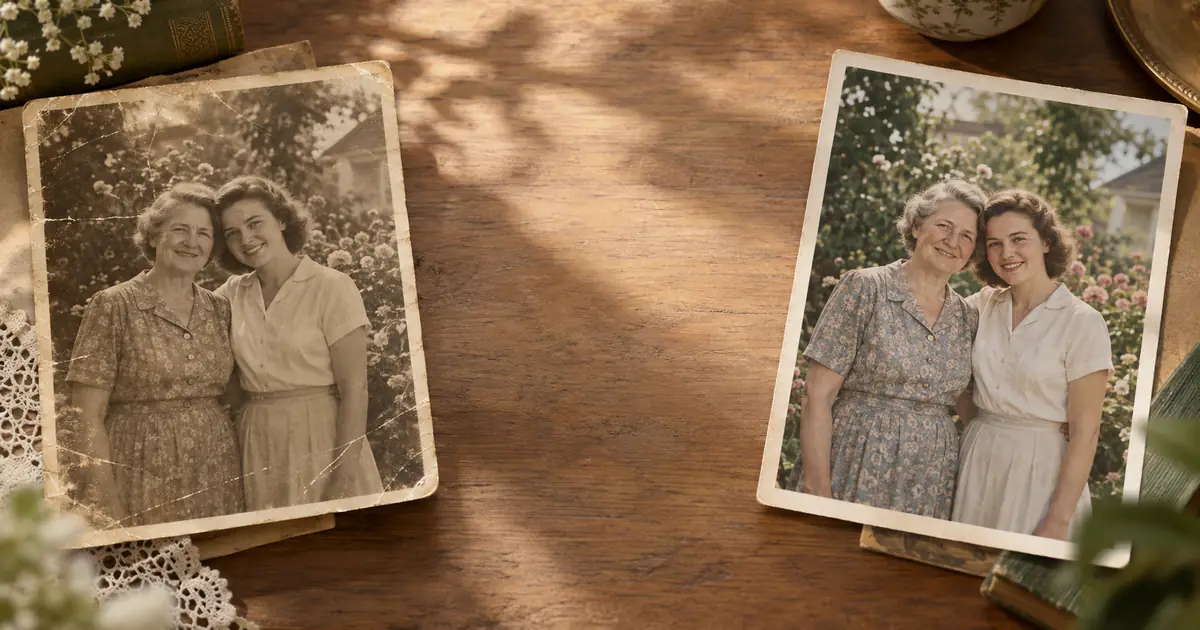
How to Restore Water Damaged Documents: Drying, Stain Removal, and Digital Recovery
Water-damaged documents face a race against mold before anything else. Learn the emergency drying protocol archivists use, what causes ink bleed and cockling, and how digital restoration recovers legibility afterward.
ArtImageHub Editorial Team
Prices and project totals in this article are reference estimates. Your current ArtImageHub offer is $9.90 for a one-time payment; review the access terms at checkout before paying. Upload follows payment.
⚡ Ready to restore: Once dried and scanned, upload your document photo to ArtImageHub's Old Photo Restoration — AI recovers legibility from staining, tide lines, and ink bleed in a single pass.
Water damage to documents — from flooding, burst pipes, roof leaks, or a spilled drink — starts a race against two clocks at once. The first is chemical: wet paper cockles, inks bleed, and dyes migrate the moment water touches them. The second is biological: mold begins colonizing damp cellulose within 48 to 72 hours at room temperature, and once it does, the damage compounds fast and becomes much harder to reverse.
What you do in the first hours and days determines how much of the document survives to be digitally restored. Get the physical response right, and even severely soaked documents often recover to a legible, archivable state.
Why Do Wet Documents Deteriorate So Quickly?
Paper is made of cellulose fibers held together partly by hydrogen bonds that weaken dramatically when wet. A soaked sheet of paper loses most of its mechanical strength, becomes prone to tearing under its own weight, and swells unevenly as fibers absorb water at different rates depending on local density and prior handling.
This uneven swelling is what produces cockling — the wavy, rippled distortion visible in dried water-damaged paper. It happens because fibers expand as they absorb water and contract as they dry, and if drying isn't controlled, different areas of the sheet dry at different rates, locking in permanent waviness.
Meanwhile, most inks and many dyes are at least partially water-soluble. The moment paper is wet, capillary action carries dissolved pigment outward from its original line or printed area, producing the feathered, blurred appearance called ink bleed or ink migration. Ballpoint and inkjet inks are particularly prone to this; iron gall ink and traditional printing inks resist it better.
What Is the Emergency Response for Freshly Wet Documents?
Act within the first 48 hours if at all possible. Mold spores are present in nearly all environments and begin active growth in damp cellulose within 48 to 72 hours at typical room temperature and humidity. Once mold establishes, it produces both staining that AI restoration cannot fully correct and structural breakdown of the paper itself.
If you cannot dry documents immediately, freeze them. A standard household freezer halts both mold growth and further ink migration, buying time — days to weeks — until you can process the documents properly. Place documents in freezer bags or wrap in freezer paper to prevent additional moisture exposure, and freeze as flat as the situation allows.
For a manageable number of loose sheets, air-dry immediately. Lay sheets flat on an absorbent surface — clean towels or blotting paper — in a single layer, not stacked. Interleave with paper towels or unprinted newsprint if drying multiple sheets, changing the interleaving as it becomes saturated. Increase air circulation with fans, but avoid direct heat, which accelerates cockling and can set stains permanently.
Do not force apart stuck-together wet sheets. Swollen wet fibers interlock, and forcing separation tears surface content away with the paper. If sheets resist separation, freeze the stack and work through it gradually, or consult a conservator for humidification-based separation once dry.
What Should You Never Do to a Water-Damaged Document?
Never use a microwave or oven to dry paper. Both introduce uneven, excessive heat that can scorch paper, accelerate cockling into permanent deformation, and in the case of a microwave, poses a fire risk with paper that has residual moisture.
Never iron a wet or damp document. Direct heat and pressure can set stains permanently, melt certain modern inks, and scorch paper that dries faster on the surface than in its interior fibers.
Never leave wet documents in a sealed plastic bag at room temperature. This creates a humid microclimate ideal for mold growth — the opposite of the freezing approach, which halts biological activity through cold rather than trapping the document in ongoing dampness.
Never scrub or blot vigorously at wet ink. Any friction on wet, weakened paper risks tearing fibers and spreading ink further rather than absorbing it. Blot gently with light pressure only, using a clean absorbent material, and let capillary action do the work rather than force.
Physical Recovery and Digital Restoration After Physical Intervention
Water-damaged document recovery has a hard boundary between what physical intervention can achieve and what happens afterward in a digital restoration pass.
Physical Recovery Handles
Drying, mold prevention, and stabilizing the physical structure of the paper are exclusively physical-intervention problems. No digital process can dry a document, stop active mold growth, or prevent further fiber damage from continued dampness — these require the emergency response described above, executed as quickly as circumstances allow.
What physical recovery cannot fix: Once dry, staining, tide lines, ink bleed, and cockling-related tonal unevenness remain baked into the document. Physical flattening under weight after drying can reduce some cockling, but the color and tonal distortions from water contact are permanent physical changes to the paper and ink that pressing alone does not remove.
What Digital Restoration Handles After Physical Recovery
Once the document is dry, flat, and scanned, ArtImageHub's Old Photo Restoration addresses what physical recovery cannot:
Tide line and stain correction: The AI recognizes water-stain patterns — characteristic ring and gradient shapes — as a tonal distortion layer and corrects for it, recovering more even, legible document tone underneath.
Ink bleed mitigation: Where ink has feathered but the original character shapes remain partially distinguishable, restoration models sharpen edge definition and improve legibility, though severely bled text that has become illegible cannot be reconstructed from information that no longer exists in the scan.
Overall tonal recovery: Uneven drying often leaves documents with patchy brightness and contrast. AI restoration normalizes this, producing a more uniform, readable result across the full page.
The complete workflow: assess urgency → freeze if drying cannot start immediately, or air-dry flat with interleaving → flatten under weight once fully dry → scan at 300-600 DPI → upload to ArtImageHub → review → archive.
When Should You Call a Professional Conservator?
For documents with significant historical, legal, or monetary value, active mold growth, or damage extensive enough that you're uncertain whether safe handling is possible, a professional paper conservator is the right resource before attempting any DIY drying or cleaning. Conservators have access to controlled freeze-drying chambers, mold remediation protocols, and page-separation techniques for stuck-together bound volumes that go well beyond home intervention safely.
For most single-incident water damage — a spilled drink, a leaking pipe affecting a folder of documents — the emergency response above, followed by AI photo restoration once scanned, recovers the large majority of practical legibility without professional intervention.
What Is the Step-by-Step Recovery Workflow?
- Assess: can you begin drying within 24-48 hours? If not, freeze immediately.
- If drying now: separate sheets if they release easily, lay flat with interleaving, increase air circulation, avoid direct heat.
- Once fully dry, flatten remaining cockling under weight for 24-48 hours between clean, dry blotting paper.
- Scan at 300-600 DPI in color, even for black-and-white documents.
- Upload to Old Photo Restoration — $9.90 one-time access.
- Review the restored result, download, and archive in acid-free storage.
Water damage moves fast, but most documents survive it if the first hours are handled correctly. Freeze what you can't dry immediately, dry the rest carefully, and let ArtImageHub's Old Photo Restoration recover the legibility that staining and ink bleed left behind.
Share this article
Ready to Restore Your Old Photos?
Try ArtImageHub's AI-powered photo restoration. Bring faded, damaged family photos back to life in seconds.