
How to Restore Old Handwritten Letters: Preservation and Digital Recovery
Old handwritten letters carry irreplaceable family history in fragile paper and fading ink. Learn how to handle, store, and digitally restore correspondence without losing the personal details that matter most.
ArtImageHub Editorial Team
Prices and project totals in this article are reference estimates. Your current ArtImageHub offer is $9.90 for a one-time payment; review the access terms at checkout before paying. Upload follows payment.
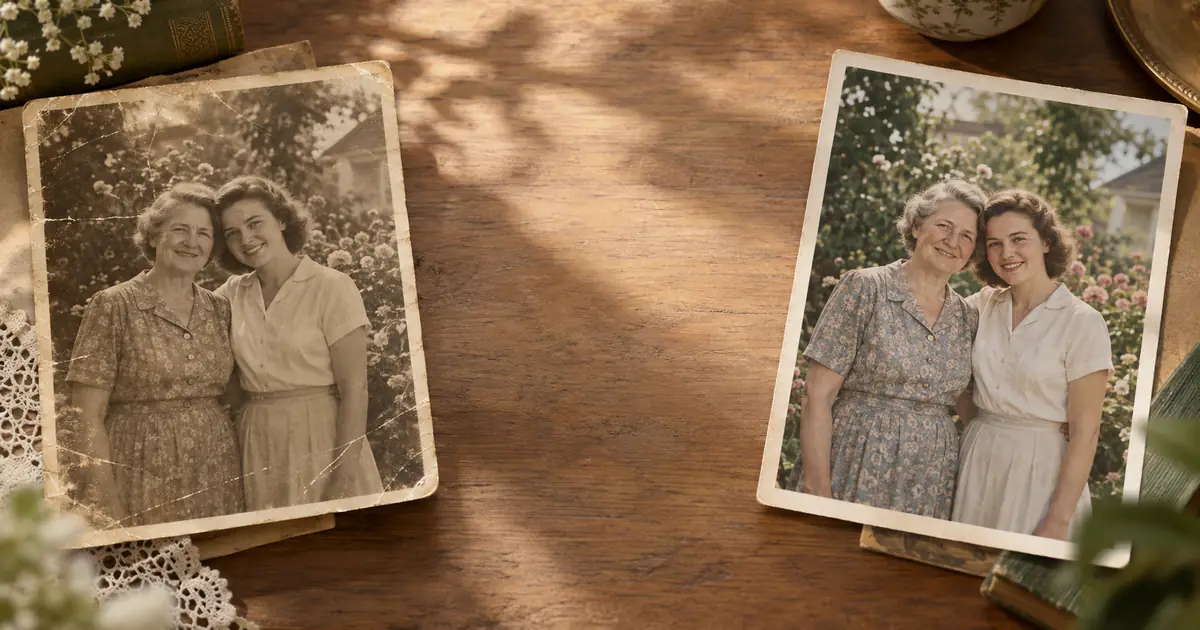
⚡ Ready to restore: Once safely unfolded and scanned, upload your letter photo to ArtImageHub's Old Photo Restoration — AI recovers legibility and clarity from fading, creasing, and age damage in a single pass.
Old handwritten letters occupy a unique place among family documents — they carry not just information but voice, the specific words a person chose to write to another person, often decades or generations ago. That personal quality makes correct preservation matter more than with most other paper documents: the goal isn't just legibility, but keeping the letter itself intact for as long as possible.
Why Are Old Letters Especially Fragile?
Letters were rarely written with archival preservation in mind. Most were folded for mailing, creating permanent stress lines along the fold that weaken over decades of storage. Many were written on inexpensive, high-acid wood-pulp paper that yellows and becomes brittle far faster than higher-quality rag paper. Ink choices varied widely — fountain pen ink, ballpoint, pencil — each with different fading and bleeding characteristics.
Add typical decades of storage in attics, basements, or shoeboxes with fluctuating humidity and temperature, and letters frequently arrive at the present in a state of significant fragility: brittle folds, faded ink, foxing, and sometimes water or insect damage layered on top of the original creasing.
How Should You Safely Unfold a Creased Letter?
Never force a fold open on brittle paper. Old creases become genuine stress points where the paper fibers have weakened; forcing a fold open on brittle paper often cracks it cleanly along that line, sometimes separating the letter into pieces.
Use a humidity chamber for resistant folds. A sealed container — a plastic bin or large zip bag works — with a shallow dish of water inside, and the folded letter suspended above the water on a rack or screen (never touching the water directly), left for 30 to 60 minutes. The humidity relaxes paper fibers enough to allow gentle unfolding without cracking.
Support the full letter as you unfold. Work slowly, supporting the paper across its full surface rather than pulling at a single corner or edge, which concentrates stress exactly where you're most likely to cause a tear.
Should Letters Stay With Their Original Envelopes?
Generally yes, but stored together rather than the letter inside the envelope. The envelope frequently carries information the letter itself doesn't repeat — a postmark with a precise date, a return address confirming where the writer was living, sometimes a stamp with its own collector or historical value. Store both in the same archival folder or sleeve so they stay associated without the letter being folded to fit inside the envelope indefinitely.
If a letter has become physically stuck to its envelope or to another page, don't force separation. A humidity chamber, used the same way as for stuck folds, can often release the bond gently. For valuable or especially fragile correspondence, a conservator can safely separate stuck pages using professional humidification equipment.
How Should You Store Letters Long-Term?
Individual acid-free, lignin-free folders or sleeves protect against the acid migration that ordinary paper and cardboard storage can cause over time. Store letters flat rather than folded whenever the paper's condition allows — flat storage prevents new creases and stops existing fold lines from deepening further under continued stress.
Choose a cool, dry, dark storage location, avoiding basements and attics where temperature and humidity swing most dramatically across seasons. If a letter must remain folded because of its size or fragility, refold along the original crease lines rather than creating new ones, which distributes stress along paper that's already adapted to that specific fold pattern rather than introducing a fresh weak point.
Physical Handling and Digital Restoration After Physical Intervention
Letter preservation divides between the physical care that protects the original document and the digital restoration that recovers legibility from the resulting scan.
What Physical Handling Handles
Safe unfolding, proper storage, and preventing further deterioration through humidity control are exclusively physical-care tasks. This is what protects the letter itself for future generations, independent of any digital copy you make.
What physical handling cannot fix: Once a letter has faded, yellowed, or developed foxing, careful physical handling prevents further damage but does not reverse the discoloration or fading that has already occurred. That recovery happens digitally, after a good scan.
What Digital Restoration Handles After Physical Handling
Once the letter is safely unfolded and scanned, ArtImageHub's Old Photo Restoration addresses the visual damage:
Fading and contrast recovery: Faded handwriting is enhanced for legibility, often significantly improving readability of text that's difficult to make out in the original.
Yellowing and foxing correction: The warm, uneven discoloration common in aged letter paper is corrected as part of tonal recalibration, producing a cleaner, more neutral background against which the handwriting reads more clearly.
Crease and fold-line reduction: The visual disruption from old fold lines is reduced, though the physical crease in the original paper itself remains — this is a visual, not structural, improvement.
The complete workflow: assess fold condition → humidify if creases resist gentle unfolding → unfold slowly with full support → scan flat at 300-600 DPI in color → upload to ArtImageHub → review → store in acid-free folder, flat if possible.
How Do You Preserve the Story, Not Just the Paper?
The physical letter is only part of what makes correspondence valuable — who wrote it, who received it, and why it mattered are context that often exists only in family memory and is easily lost between generations. Document what you know alongside the physical preservation work: names, approximate dates, and the family history that explains the letter's significance.
Consider transcribing the text itself, both to improve accessibility for family members who might struggle with old handwriting styles, and as a content backup independent of the physical paper's condition, which even the best preservation cannot guarantee indefinitely.
What Is the Step-by-Step Preservation Workflow?
- Assess condition: are folds brittle and resistant, or does the letter open easily?
- Humidify resistant folds in a sealed chamber for 30-60 minutes before attempting to unfold.
- Unfold slowly with full support across the paper surface.
- Scan flat at 300-600 DPI in color.
- Upload to Old Photo Restoration — $9.90 one-time access.
- Review the restored result and store the original flat in an acid-free folder.
- Document names, dates, and family context alongside the preserved letter.
Old handwritten letters hold voices that don't survive anywhere else. Handle the physical paper gently, store it properly, and let ArtImageHub's Old Photo Restoration recover the legibility that time has faded.
Share this article
Ready to Restore Your Old Photos?
Try ArtImageHub's AI-powered photo restoration. Bring faded, damaged family photos back to life in seconds.