Restoring Photos Across Multiple Generations: A Family History Project
How to approach photo restoration as a multi-generational family history project. Organizing, prioritizing, and restoring photographs spanning 100+ years.
ArtImageHub Editorial Team
Helen's family project was ambitious: photographs spanning five generations, from a daguerreotype of her great-great-grandparents from approximately 1865 to digital snapshots from last Christmas. The oldest photograph was a case-mounted daguerreotype; the newest was a smartphone image. Between them: albumen prints, gelatin silver prints, Kodacolor, Ektachrome slides, Polaroids, and 35mm negatives.
Each format has different degradation characteristics, different scanning requirements, different restoration approaches. This is a common situation for families undertaking serious photographic genealogy — and it requires a systematic approach.
Phase 1: Inventory and Condition Assessment
Before any scanning or restoration work, catalog what you have. For each photograph, note:
- Approximate date (decade is usually sufficient)
- Format (print, negative, slide)
- Subject (who or what is shown)
- Condition (excellent, good, fair, poor)
- Priority (irreplaceable, important, nice to have)
This inventory serves as your project roadmap and ensures nothing gets overlooked.
Phase 2: Scanning Strategy
Different formats require different scanning approaches.
Daguerreotypes and cased images: These cannot be scanned on a standard flatbed scanner. They require photographing with a camera and careful lighting to avoid the characteristic reflections that obscure the image. Professional digitization is often worth the cost for these.
Prints: Flatbed scanner, 600-1200 DPI depending on size. Higher DPI for smaller prints.
35mm slides and negatives: A scanner with a transparency adapter, or a dedicated film scanner. 2400-4000 DPI for slides and negatives.
Large-format negatives: Professional scanning or copy photography.
Phase 3: Restoration Prioritization
With a large project, prioritizing restoration effort is essential. I suggest:
Tier 1: Only surviving photographs of individuals (great-grandparents and earlier). These are irreplaceable and deserve the most careful restoration work.
Tier 2: Key family milestone photographs — weddings, graduations, significant occasions.
Tier 3: Context photographs — locations, daily life, occasions that provide historical background.
Tier 4: Duplicates and casual snapshots. Batch-process these with lighter-touch restoration.
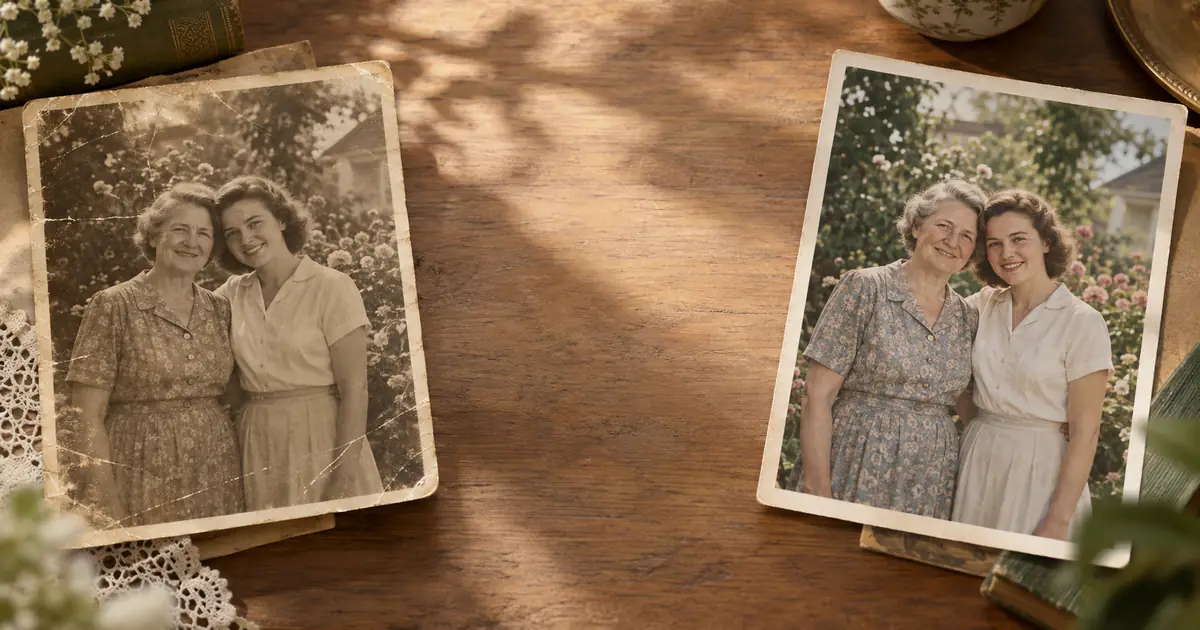
Helen's project took six months from initial inventory to completed archive. The result was a digital collection of 847 restored photographs, organized by generation and date, with notes identifying subjects and contexts.
Start your multi-generational restoration project at our photo restoration tool.
Share this article
Ready to Restore Your Old Photos?
Try ArtImageHub's AI-powered photo restoration. Bring faded, damaged family photos back to life in seconds.