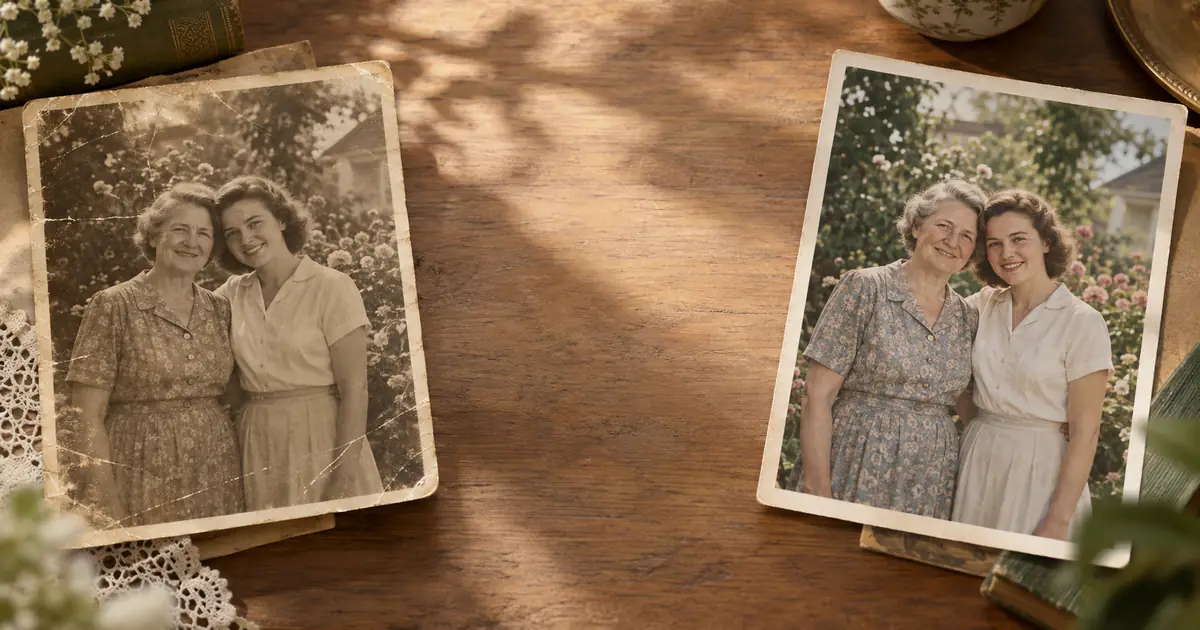
ArtImageHub vs Adobe Photoshop: Which Is Better for Old Photo Restoration?
ArtImageHub vs Adobe Photoshop for restoring old family photos. Comparing Neural Filters, scratch repair, face enhancement, skill required, and cost per photo.
ArtImageHub Editorial Team
Editorial trust notice: This guide is published by ArtImageHub, an AI photo restoration service charging $9.90 one-time. Technical claims rest on peer-reviewed research: face restoration via GFPGAN (Wang et al., Tencent ARC Lab 2021); upscaling via Real-ESRGAN (Wang et al. 2021).
Updated 2026-05-01: AI model lineage clarified — most consumer photo restoration tools (including those compared here) wrap derivatives of GFPGAN (arXiv:2101.04061, Tencent ARC Lab 2021) for face restoration and Real-ESRGAN (arXiv:2107.10833, 2021) for upscaling. Differences between products are mostly pricing model and workflow, not raw AI quality.
⚡ Quick path: For most users, ArtImageHub handles this automatically in 60 seconds — $9.90 one-time, no subscription, no watermark on HD download. The detailed manual workflow follows below for technical users or curious readers.
Adobe Photoshop is the world's most powerful image editing software. It's the industry standard for professional photographers, designers, and restoration artists. Its Neural Filters include AI-powered tools for colorization and face enhancement.
ArtImageHub is a purpose-built web tool for restoring old, damaged, or faded photographs using AI — no editing skills required.
Here's how they actually compare when the goal is restoring an old family photo.
The Fundamental Difference
Adobe Photoshop is a tool for skilled editors. Photoshop can produce exceptional results on old photo restoration — but only if the person using it knows what they're doing. Healing Brush, Clone Stamp, Neural Filters for colorization and face enhancement, frequency separation, curves — all of these can be applied to damaged photos by a trained professional. Whether you're tackling a photo torn in quarters or chasing detail in motion-blurred old prints, Photoshop gives a skilled operator the full toolkit.
Used well, Photoshop can restore photos that no AI tool can match. Used by someone without those skills — and most people don't have those skills — it produces poor results at high time cost.
ArtImageHub does the work automatically. Upload a photo, wait 30–90 seconds, download the restored version. The AI applies:
- CodeFormer — face restoration trained specifically on degraded historical photographs
- GFPGAN — image-wide enhancement including fading, color, and texture
- Real-ESRGAN — AI upscaling integrated in the same processing pass
- Damage repair — scratch, tear, and artifact removal
The output is not manually crafted — it's algorithmic. But for typical family photos, the results are consistently strong without requiring any editing knowledge.
Skip the manual work? Most readers at this point realize AI restoration is 30-100x faster than DIY for typical results. Try AI restoration on this photo → — $9.90 once, unlimited HD downloads, no subscription.
Pricing
Adobe Photoshop:
- Photography Plan: $19.99/month (Photoshop + Lightroom)
- Photoshop only: $22.99/month
- Creative Cloud All Apps: $59.99/month
- Annual commitment required for lowest pricing
- Student/Teacher pricing: ~$19.99/month for All Apps
ArtImageHub:
- $9.90 one-time
- Covers upload, AI processing, and HD download
- No subscription, no credits, no monthly commitment
For someone restoring a box of family photos over a weekend, the cost comparison is:
- Photoshop (already subscribed): $0 additional, but significant time investment learning and applying
- Photoshop (new subscriber): $20/month minimum — and still requires learning
- ArtImageHub: $9.90 for the entire project
Skill Requirement
Photoshop: High. To do quality old photo restoration in Photoshop, you need to understand:
- Layer structure and masking
- Healing Brush and Clone Stamp technique
- Frequency separation for texture repair
- Curves and Levels for tonal correction
- Neural Filters (colorization, Smart Portrait)
- Spot healing vs Content-Aware fill — when to use which
Learning to do this well takes months to years of practice. Tutorials exist, but applying them consistently to varied old photos is a skill, not a recipe.
ArtImageHub: None. Upload, wait, download.
Photoshop's Neural Filters for Old Photos
Photoshop's AI features most relevant to old photo restoration:
Colorize (Neural Filter): Good for black-and-white conversion. Results are plausible but can produce flat, uniform colors — especially on skin tones and complex textures. Manual touchup is typically needed for professional results. If you're working through how to colorize black-and-white photos on a specific era — like 1920s studio portraits or 1940s wartime photographs — you'll need to feed Photoshop era-accurate palette references by hand. For Civil War-era colorization, period uniform colors are especially unforgiving of the Neural Filter's default guesses.
Smart Portrait (Neural Filter): Can smooth skin and adjust facial features, but is designed for modern portrait enhancement — not for recovering face detail from a 1960s print with soft focus and fading. This becomes obvious when you try enhancing small cropped faces or sharpening faces in a group photo — Smart Portrait assumes modern sensor detail that simply isn't in the source pixels.
Content-Aware Fill: Useful for filling in areas where physical damage (tears, missing corners) has destroyed content. Requires manual selection and can produce inconsistent results depending on the surrounding content.
Spot Healing Brush: Excellent for removing scratches and small damage — but requires manual brushwork on each damaged area. On a severely scratched print, this could take hours. The same applies when fixing out-of-focus old photos: Photoshop's sharpen filters can help but won't invent detail the lens never captured.
Bottom line on Neural Filters: They're supplementary tools in a skilled editor's workflow, not a push-button restoration solution. They work best on top of extensive manual preparation.
Feature Comparison
| Feature | ArtImageHub | Adobe Photoshop |
|---|---|---|
| Price | $9.90 one-time | $19.99–$22.99/month |
| Old photo restoration | Core feature | Possible with skill |
| Skill required | None | Intermediate to advanced |
| Scratch/damage repair | Automatic | Manual (Healing Brush) |
| Face enhancement | Yes (CodeFormer) | Neural Filters (modern focus) |
| Upscaling | Yes (integrated) | Yes (Super Resolution) |
| Colorization | Yes (AI) | Yes (Neural Filter, manual) |
| Batch processing | Single photo | Yes (Actions) |
| API access | No | No (desktop app) |
| Platform | Web (any browser) | Desktop (Win/Mac) |
| Installation required | No | Yes |
| Processing time | 30–90 seconds | Hours (manual restoration) |
Where Photoshop Wins
Professional-grade output for skilled users. In the hands of an experienced restoration artist, Photoshop produces results that surpass any AI tool — particularly for complex restoration involving missing areas, severe tears, or historically significant images where accuracy matters.
Content-Aware Fill for structural damage. For photos with significant missing sections — torn corners, large water damage patches — Photoshop's Content-Aware Fill combined with manual Clone Stamp work can reconstruct content that AI tools struggle with.
Full editorial control. Every decision is manual and reversible. You can choose exactly how much colorization to apply, which scratches to remove and which to preserve, how far to push face enhancement before it looks artificial.
Batch automation. For studios or archives processing large volumes with consistent settings, Photoshop Actions and Bridge can automate workflows at scale. This matters if you're digitizing a large photo collection or digitizing and restoring slides, where consistent per-image treatment across hundreds of files is the bottleneck. Prep steps like cleaning photos before scanning and improving photo scan quality happen outside Photoshop, but determine how much manual cleanup the Actions need to do. Archivists also benefit from identifying old photo formats so each batch gets format-appropriate settings.
Creative flexibility. Photoshop can do far more than restoration — compositing, color grading, retouching, design work. If you're already using it for other purposes, adding restoration to your workflow costs nothing extra.
Where ArtImageHub Wins
No skill required. The most significant practical advantage. Most people who want to restore an old family photo are not Photoshop experts and have no interest in becoming one. ArtImageHub requires exactly zero knowledge of image editing.
Speed. 30–90 seconds vs hours of manual work per photo. For restoring a shoebox of family prints, the time difference is measured in weekends vs a single afternoon.
Face restoration on old photographs. CodeFormer was specifically trained to recover face detail from degraded historical photographs. Photoshop's Smart Portrait filter is designed for modern portraits — it doesn't understand the specific softness and grain patterns of old prints. The difference is visible on photos from the 1940s–1980s.
Cost for one-time use. $9.90 for everything vs $19.99/month minimum. For someone who wants to restore 5–10 photos for a gift or family reunion, ArtImageHub is significantly cheaper and faster.
Accessibility. Works in any browser on any device. No download, no subscription, no software updates.
When Photoshop Is Worth It
- You're a skilled editor already proficient in restoration techniques
- The photos have significant structural damage (large missing sections) requiring manual reconstruction
- You need complete editorial control over every restoration decision
- You're already paying for Creative Cloud for other purposes
- You're restoring historically or archivally significant photographs where accuracy is paramount
When ArtImageHub Is Worth It
- You have typical old family photos: fading, scratches, color shift, soft faces
- You don't have Photoshop skills (or time to develop them)
- This is a one-time project — a gift, family album, memorial
- You want results in minutes, not hours
- You need colorization included without additional tools or manual work
Restoration Quality: Realistic Assessment
For a typical old family photo — a 1960s print with moderate fading, some light scratches, and faces that have lost sharpness:
Photoshop (beginner): Patchy results. Healing Brush applied without technique introduces texture artifacts. Neural Filter colorization is flat. Face enhancement adds AI-smoothed skin that looks wrong against the photo's natural grain. Better than the original in some ways; worse in others.
Photoshop (skilled): Exceptional results possible. A good restoration artist spending 2–4 hours on a single photo can produce museum-quality output. But most people are not skilled restoration artists, and paying one costs $50–$200 per photo.
ArtImageHub: Consistent, strong results for typical family photos. Scratches reduced, faces reconstructed with CodeFormer, fading corrected, resolution improved. Not every photo will be perfect — very badly damaged originals have limits — but the 30-second result is often comparable to what a beginner could achieve in Photoshop after 2 hours.
Bottom Line
Photoshop is the better tool — in the right hands. If you have the skills and the subscription, Photoshop gives you control that no AI tool matches.
For most people restoring family photos, ArtImageHub is the better choice. The skill floor doesn't exist, the cost is lower, and the time investment is minutes instead of hours.
Restore your old family photos at ArtImageHub — $9.90 one-time →
Results in 30–90 seconds · HD download · 30-day guarantee
Once restored, the next question is usually how to print restored photos at archival quality — the same file that looks great on screen may need sharpening or resampling for print.
Related Comparisons
- ArtImageHub vs Remini — in-depth 6-tool test on 100 family photos
- ArtImageHub vs Let's Enhance — AI upscaling vs old photo restoration
- ArtImageHub vs MyHeritage Photo Enhancer — face enhancement and colorization compared
- ArtImageHub vs VanceAI — credits model vs one-time pricing
- ArtImageHub vs Fotor — full photo editor vs focused restoration tool
- ArtImageHub vs Topaz Gigapixel AI — professional upscaling vs damage repair
Quick method comparison: AI vs DIY vs Professional
| Method | Time per photo | Cost | Skill required | Result quality |
|---|---|---|---|---|
| AI (ArtImageHub) | 60 seconds | $9.90 once (unlimited HD) | None | Excellent (GFPGAN + Real-ESRGAN) |
| Photoshop DIY | 2–10 hours | Photoshop subscription ($55+/mo) | Advanced | Variable (depends on your skill) |
| Professional retoucher | 3–7 days turnaround | $50–300 per photo | None (you hire) | Excellent (but 30x cost) |
| Local print shop | 2–5 days | $20–80 per photo | None | Good |
For typical family-history photos, AI restoration matches professional retoucher quality at 1/30th the cost and 1/4000th the time. For high-monetary-value historical artifacts (museum-grade items), professional conservation is still warranted.
For era-specific damage profiles, see Old Photo Restoration by Decade complete index.
For damage-specific recovery protocols, see Old Photo Damage Recovery by Type complete guide.
Try ArtImageHub directly — $9.90 one-time for unlimited HD restoration.
Share this article
Ready to Restore Your Old Photos?
Try ArtImageHub's AI-powered photo restoration. Bring faded, damaged family photos back to life in seconds.