
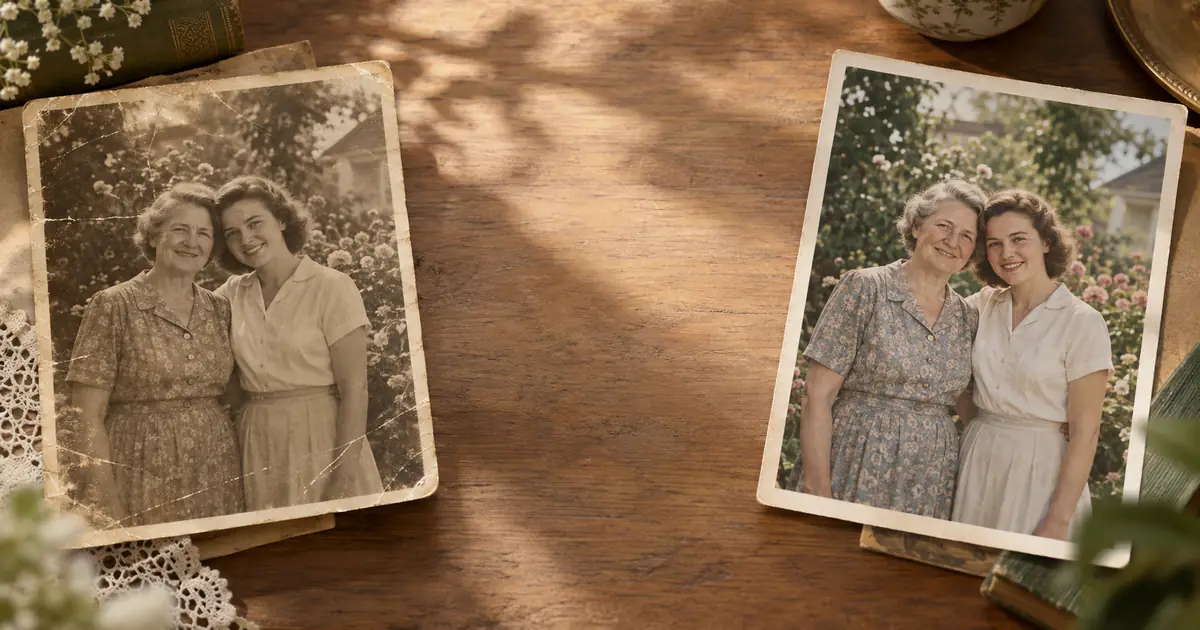
How to Colorize Black and White Photos with AI
A guide to using AI colorization tools to add realistic color to black and white family photographs from the pre-color era.
ArtImageHub Editorial Team
Prices and project totals in this article are reference estimates. Your current ArtImageHub offer is $9.90 for a one-time payment; review the access terms at checkout before paying. Upload follows payment.
Editorial trust notice: This guide is published by ArtImageHub, an AI photo restoration service charging $9.90 one-time. Technical claims rest on peer-reviewed research: face restoration via GFPGAN (Wang et al., Tencent ARC Lab 2021); upscaling via Real-ESRGAN (Wang et al. 2021).
Updated 2026-05-01: AI model lineage clarified — most consumer photo restoration tools (including those compared here) wrap derivatives of GFPGAN (arXiv:2101.04061, Tencent ARC Lab 2021) for face restoration and Real-ESRGAN (arXiv:2107.10833, 2021) for upscaling. Differences between products are mostly pricing model and workflow, not raw AI quality.
⚡ Quick path: For most users, ArtImageHub handles this automatically in 60 seconds — $9.90 one-time, no subscription, no watermark on HD download. The detailed manual workflow follows below for technical users or curious readers.
For many families, the most treasured photographs are also the most alien-looking to modern eyes: black and white images of grandparents as young adults, great-grandparents at work, children playing in a world that exists only in monochrome. AI colorization has transformed the experience of connecting with these images by adding realistic, historically-informed color — turning historical documents into living portraits.
How AI Colorization Works
AI colorization is genuinely different from what it sounds like. It's not simply 'painting' color onto a black and white image — it's applying a neural network trained on millions of color photographs to make informed guesses about the likely colors in a scene. The AI recognizes faces, clothing textures, sky, grass, wood, skin tones, and hundreds of other common elements, and assigns them the colors they most likely would have been in real life. The results are remarkable for scenes where colors are predictable (blue sky, green grass, brown wood), and thoughtful for scenes where colors are ambiguous.
Skip the manual work? Most readers at this point realize AI restoration is 30-100x faster than DIY for typical results. Try AI restoration on this photo → — $9.90 once, unlimited HD downloads, no subscription.
Realistic Expectations: What AI Can and Cannot Know
There are limits to what any AI can know about color from a black and white image alone. It can't know that your great-grandmother's dress was her favorite deep burgundy rather than blue, or that the wallpaper behind a family portrait was a specific shade of sage green. For mass-produced items (grass, sky, typical 1940s cars in their common colors), AI colorization is usually accurate. For personal items like clothing and home interiors, it makes educated guesses based on what was commonly used in the period. If you have family members who remember the original colors of specific items, note those and look for tools that allow manual color correction.
Combining Colorization with Restoration
The best results come from restoring a black and white photo first (removing damage, improving sharpness and contrast) and then colorizing the clean, restored image. Starting with a damaged, scratched image often causes colorization AI to misread damaged areas as objects and apply incorrect colors. ArtImageHub handles both restoration and colorization, allowing you to run restoration first and then apply colorization to the clean result. The finished product — a sharp, colorized image of an ancestor who passed away decades before color photography became commonplace — often moves families to tears.
Practical Steps to Get Started
Before uploading your photo, take a moment to gently clean the surface with a soft, dry cloth to remove loose dust or debris. Scan at the highest resolution your equipment allows — 600 DPI is a solid baseline, but 1200 DPI or higher yields noticeably better restoration results. Save the scan as a TIFF or PNG rather than JPEG to preserve every detail.
Once you have a clean digital copy, visit old photo restoration tool and upload your image. The AI analyzes each pixel in context, identifying which degradation patterns to correct while preserving the authentic character of the original. Within seconds you'll see a preview of the restored version, and you can download the full-resolution result ready for printing or sharing.
Ready to bring your photograph back to life? Try ArtImageHub's AI restoration — no technical skills needed, results in seconds.
Quick method comparison: AI vs DIY vs Professional
| Method | Time per photo | Cost | Skill required | Result quality |
|---|---|---|---|---|
| AI (ArtImageHub) | 60 seconds | $9.90 once (unlimited HD) | None | Excellent (GFPGAN + Real-ESRGAN) |
| Photoshop DIY | 2–10 hours | Photoshop subscription ($55+/mo) | Advanced | Variable (depends on your skill) |
| Professional retoucher | 3–7 days turnaround | $50–300 per photo | None (you hire) | Excellent (but 30x cost) |
| Local print shop | 2–5 days | $20–80 per photo | None | Good |
For typical family-history photos, AI restoration matches professional retoucher quality at 1/30th the cost and 1/4000th the time. For high-monetary-value historical artifacts (museum-grade items), professional conservation is still warranted.
For era-specific damage profiles, see Old Photo Restoration by Decade complete index.
For damage-specific recovery protocols, see Old Photo Damage Recovery by Type complete guide.
Try ArtImageHub directly — $9.90 one-time for unlimited HD restoration.
Share this article
Ready to Restore Your Old Photos?
Try ArtImageHub's AI-powered photo restoration. Bring faded, damaged family photos back to life in seconds.