
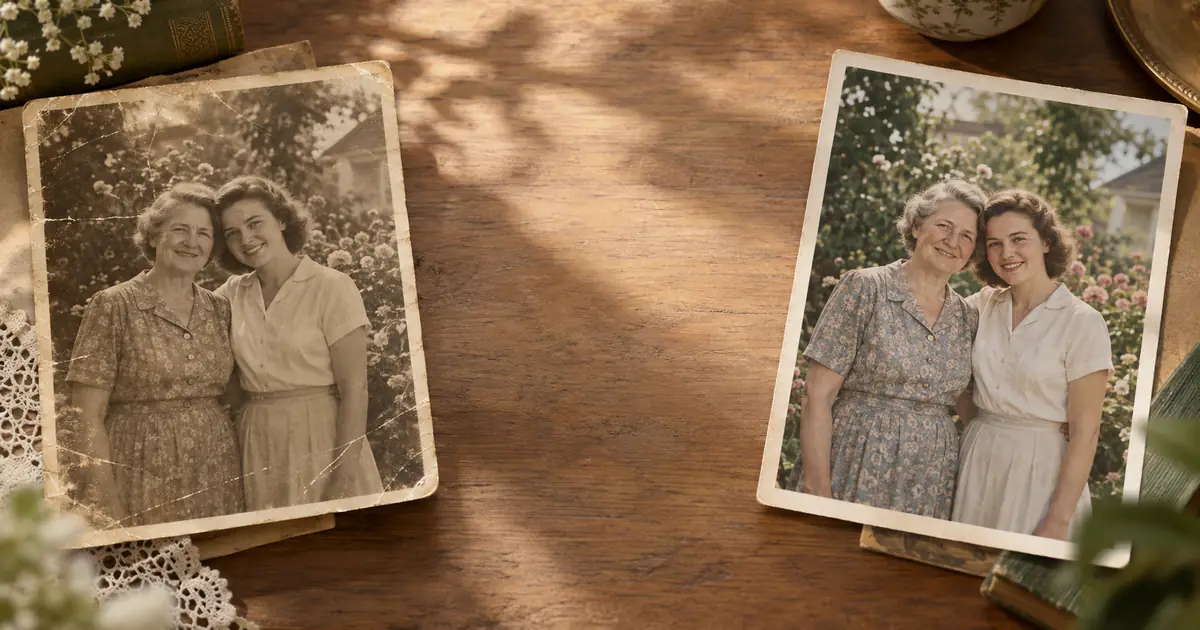
Can Stable Diffusion Restore Old Photos? (Honest Answer)
Can Stable Diffusion fix old, faded, or damaged family photos? Honest technical answer: not really — here's why image generation AI is the wrong tool, and what open-source tools actually work.
ArtImageHub Editorial Team
Prices and project totals in this article are reference estimates. Your current ArtImageHub offer is $9.90 for a one-time payment; review the access terms at checkout before paying. Upload follows payment.
Editorial trust notice: This guide is published by ArtImageHub, an AI photo restoration service charging $9.90 one-time. Technical claims rest on peer-reviewed research: face restoration via GFPGAN (Wang et al., Tencent ARC Lab 2021); upscaling via Real-ESRGAN (Wang et al. 2021).
Stable Diffusion is one of the most powerful open-source AI image generation models. It runs locally, it's free, and it's highly customizable. If you're wondering whether it can restore old, faded, or damaged family photographs, here's the direct answer:
⚡ Quick path: For most users, ArtImageHub handles this automatically in 60 seconds — $9.90 one-time, no subscription, no watermark on HD download. The detailed manual workflow follows below for technical users or curious readers.
Stable Diffusion in its standard form cannot restore old photographs. It's a generative model — it creates new images. Restoration of existing photographs is a fundamentally different task.
That said, the Stable Diffusion ecosystem is more complex than most AI tools, so this deserves a detailed explanation.
What Stable Diffusion Does
Stable Diffusion is a latent diffusion model — it generates images by progressively denoising random noise guided by a text prompt or image conditioning signal. Its primary mode is text-to-image generation.
Extended capabilities in the SD ecosystem:
img2img: Upload an image + provide a prompt → Stable Diffusion generates a new image influenced by both. The original image provides structural guidance; the model generates new content around it. This is generation, not restoration.
ControlNet: A fine-tuned extension that allows more precise structural control when generating. You can constrain the pose, depth, edges, or layout — but the model still generates new content, it doesn't repair the original.
Inpainting: Mask a region → Stable Diffusion generates new content to fill it. For old photos, this replaces damaged areas with generated content — fictional, not original.
Upscalers: Several SD-based upscalers exist (LDSR, SD Upscale). Better than bicubic upscaling but not designed for degraded historical photographs.
Skip the manual work? Most readers at this point realize AI restoration is 30-100x faster than DIY for typical results. Try AI restoration on this photo → — $9.90 once, unlimited HD downloads, no subscription.
Why Stable Diffusion Can't Truly Restore Old Photos
The core problem: Stable Diffusion is trained to generate plausible new images, not to reconstruct degraded information in existing ones.
When you run an old family portrait through img2img or ControlNet:
- The model generates a new image that looks compositionally similar
- Faces are reconstructed based on general knowledge of what faces look like
- The specific person in the original photo is not recovered — a plausible-looking substitute is generated
- Fine details that exist in the original (even degraded) are often overwritten
For genealogy or family history purposes, this matters enormously. A generated face that "looks right" is not your grandfather — it's a hallucination based on statistical patterns.
What About Restoration-Specific SD Extensions?
The SD community has experimented with restoration-adjacent workflows:
GFPGAN + Real-ESRGAN via SD UIs: Some Automatic1111/ComfyUI installations can run GFPGAN and Real-ESRGAN. These are not Stable Diffusion models — they're purpose-built restoration models that happen to be usable through SD interfaces.
CodeFormer via SD UI: Similarly, CodeFormer can be run through SD-based tools. Again, CodeFormer is a dedicated face reconstruction model, not SD itself.
SD face restoration modules: Some SD forks include face fix passes using GFPGAN after generation. These apply GFPGAN to the generated image, not to the original photo.
The pattern: when Stable Diffusion does work for old photo restoration, it's because purpose-built restoration models (CodeFormer, GFPGAN, Real-ESRGAN) have been integrated into SD-based tools. The restoration capability comes from those models, not from SD.
The Technical Reality
| Model | Type | Old Photo Use |
|---|---|---|
| Stable Diffusion (base) | Image generation | ❌ Generates new content |
| img2img | Image-guided generation | ❌ Still generative |
| ControlNet | Structured generation | ❌ Still generative |
| GFPGAN (via SD UI) | Restoration | ✅ Reconstructs face detail |
| CodeFormer (via SD UI) | Restoration | ✅ Best for historical faces |
| Real-ESRGAN (via SD UI) | Restoration upscaling | ✅ Degraded image upscaling |
Who Should Use Stable Diffusion for Old Photos
Technical users who want free local processing: If you're comfortable setting up Automatic1111 or ComfyUI, adding GFPGAN and CodeFormer extensions, and running a restoration pipeline — this is technically possible and free.
Privacy-sensitive users: Running locally means photos never leave your machine.
The tradeoffs: significant technical setup, not beginner-friendly, requires a capable GPU (8GB+ VRAM), and the restoration quality comes from GFPGAN/CodeFormer, not SD itself.
For Everyone Else
The same CodeFormer + GFPGAN + Real-ESRGAN pipeline that SD power users run locally is what ArtImageHub runs in the cloud — no setup required, no GPU needed, $9.90, results in 30–90 seconds.
Comparison
| Task | Stable Diffusion | ArtImageHub |
|---|---|---|
| Restore original face detail (old photos) | ❌ SD alone cannot; GFPGAN/CF add-ons can | ✅ CodeFormer built-in |
| Fix fading and yellowing | ❌ SD alone cannot; GFPGAN add-on can | ✅ GFPGAN built-in |
| Remove scratches from old prints | ❌ Inpainting generates new content, not original | ✅ AI pattern recognition |
| Colorize black-and-white | ⚠️ Possible but generated, not historically accurate | ✅ Yes |
| Setup required | Significant (GPU, VRAM, extensions) | None |
| Cost | Free (if you have hardware) | $9.90 one-time |
Restore your old family photos at ArtImageHub — $9.90 one-time →
Results in 30–90 seconds · HD download · 30-day guarantee
Related
- Can Midjourney Restore Old Photos? — Midjourney analysis
- Can ChatGPT Restore Old Photos? — ChatGPT/GPT-4o analysis
- Can Google Gemini Restore Old Photos? — Gemini analysis
Quick method comparison: AI vs DIY vs Professional
| Method | Time per photo | Cost | Skill required | Result quality |
|---|---|---|---|---|
| AI (ArtImageHub) | 60 seconds | $9.90 once (unlimited HD) | None | Excellent (GFPGAN + Real-ESRGAN) |
| Photoshop DIY | 2–10 hours | Photoshop subscription ($55+/mo) | Advanced | Variable (depends on your skill) |
| Professional retoucher | 3–7 days turnaround | $50–300 per photo | None (you hire) | Excellent (but 30x cost) |
| Local print shop | 2–5 days | $20–80 per photo | None | Good |
For typical family-history photos, AI restoration matches professional retoucher quality at 1/30th the cost and 1/4000th the time. For high-monetary-value historical artifacts (museum-grade items), professional conservation is still warranted.
For era-specific damage profiles, see Old Photo Restoration by Decade complete index.
For damage-specific recovery protocols, see Old Photo Damage Recovery by Type complete guide.
Try ArtImageHub directly — $9.90 one-time for unlimited HD restoration.
Share this article
Ready to Restore Your Old Photos?
Try ArtImageHub's AI-powered photo restoration. Bring faded, damaged family photos back to life in seconds.