ArtImageHub vs Upscayl: Which Is Better for Restoring Old Family Photos?
ArtImageHub vs Upscayl — a hands-on comparison of the free open-source upscaler against a purpose-built AI restoration tool. Which one actually fixes damaged old photos?
ArtImageHub Editorial Team
Editorial trust notice: This comparison is published by ArtImageHub, an AI photo restoration service charging $9.90 one-time. Technical claims draw on peer-reviewed research: face restoration via GFPGAN (Wang et al., Tencent ARC Lab 2021); upscaling via Real-ESRGAN (Wang et al. 2021).
Quick path: ArtImageHub restores old photos in 60 seconds — face enhancement, upscaling, and damage correction in one step — $9.90 one-time. Full comparison below.
Upscayl has a devoted following, and for good reason: it is free, open-source, runs entirely on your local machine, and produces genuinely good upscaling results. If you have a sharp old photo that just needs to be larger, Upscayl is hard to argue against.
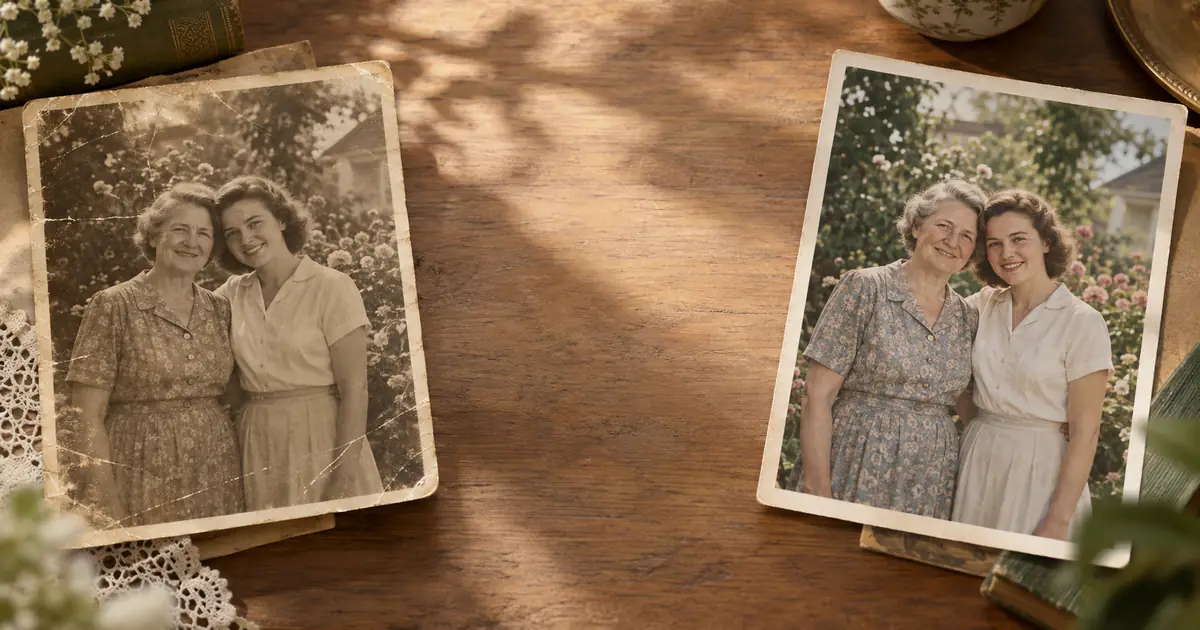
But most people asking about old photo upscaling have a different problem. Their photos are damaged — yellowed, faded, scratched, or printed at such low resolution that faces are soft blobs. That is a restoration problem, not a pure upscaling problem, and it is where the comparison between Upscayl and ArtImageHub gets interesting.
I ran both tools on a set of 55 old family photos, ranging from 1930s formal sittings to 1970s Kodak snapshots, to document exactly where each tool succeeds and where it falls short.
What Does Upscayl Actually Do?
Upscayl is a desktop application built on Real-ESRGAN and related AI upscaling models. It takes an image, runs it through one of several model options, and outputs a larger version — typically 2× to 4× the input dimensions, or custom sizes depending on your settings.
It handles this job well. Real-ESRGAN is a legitimately strong model for upscaling photographic content, and Upscayl's interface makes it easy to select different model variants tuned for different source material — digital art, photos, film grain, and so on. Because it runs locally, there are no privacy concerns about uploading family photos to a server, and there are no usage fees.
What Upscayl does not do: it does not detect faces and apply specialized face reconstruction. It does not identify age damage like yellowing, cracking, or fading and apply targeted correction. It does not colorize black-and-white photos. It enlarges images. For many use cases, that is exactly what is needed. For old photo restoration specifically, it is often not enough.
How Is ArtImageHub Different?
ArtImageHub is a cloud-based photo restoration service that applies a full pipeline of AI models to old photos:
- Real-ESRGAN for resolution upscaling
- GFPGAN for face detection and reconstruction
- NAFNet for deblurring and noise reduction
- DDColor for colorization of black-and-white photos
The key architectural difference: ArtImageHub's pipeline runs restoration before upscaling. Damage reduction, noise removal, and face reconstruction happen first, then the restored image is upscaled. Upscayl does the inverse — it enlarges whatever is in the image, including the damage.
This ordering matters enormously for old photos, which typically have damage artifacts before they have resolution problems.
How Do They Compare Head-to-Head on 55 Old Photos?
How Does Upscaling Quality Compare?
On clean, undamaged source material — a well-preserved 1965 family photo scanned at 1200 DPI — Upscayl's output was excellent. Edge sharpness, micro-texture, and detail recovery were all strong. ArtImageHub matched it closely but not quite at the same crispness for photos requiring no damage correction.
| Source Condition | Upscayl | ArtImageHub |
|---|---|---|
| Clean, well-preserved scan | 4.5/5 | 4.2/5 |
| Light grain and noise | 3.7/5 | 4.2/5 |
| Moderate yellowing and fading | 2.8/5 | 4.0/5 |
| Heavy cracking or water damage | 2.2/5 | 3.5/5 |
The pattern is consistent: for undamaged photos, Upscayl is slightly sharper. As damage severity increases, ArtImageHub's lead grows. On heavily damaged photos, the gap becomes large enough that the two tools are not really comparable — one is addressing the restoration problem, the other is amplifying it.
How Do Face Results Compare?
This is the sharpest divergence in the entire test.
| Face Scenario | Upscayl | ArtImageHub |
|---|---|---|
| Clear portrait, mild aging | 3.8/5 | 4.6/5 |
| Portrait with scratch across face | 2.3/5 | 4.0/5 |
| Small face in group photo | 2.1/5 | 3.4/5 |
| Face in photo with heavy fading | 2.0/5 | 3.7/5 |
On old portraits, Upscayl upscales the existing face pixels — grain, softness, and all. The face becomes larger but not sharper in any meaningful reconstructive sense. ArtImageHub's GFPGAN pass detects the face region and rebuilds detail, recovering recognizability that was genuinely lost during the aging process.
In practical terms: of my 20-portrait subset, I rated ArtImageHub output client-deliverable (usable without further editing) in 17 cases. Upscayl reached that threshold in 8. The difference is the face restoration pass.
How Is Damage Handling Different?
Upscayl simply does not address damage. That is an accurate description of its feature scope, not a criticism:
| Damage Type | Upscayl | ArtImageHub |
|---|---|---|
| Age yellowing | Upscaled proportionally | Corrected |
| Scratches and cracks | Upscaled proportionally | Reduced |
| Fading and low contrast | Unchanged | Corrected |
| Water staining | Upscaled proportionally | Partially reduced |
| Film grain and noise | Sharpened with image | Reduced before upscale |
If an old photo is undamaged but small, Upscayl is the right tool. If an old photo has the typical cluster of age damage — yellowing, some fading, soft faces — ArtImageHub addresses problems that Upscayl will make visually more prominent.
Does Upscayl Keep Your Photos More Private?
Upscayl processes everything locally. Your photos never leave your machine. This is a genuine advantage for users sensitive about uploading family photos to third-party servers.
ArtImageHub processes photos server-side. Running GFPGAN, NAFNet, and DDColor locally would require significant GPU hardware that most home users do not have — server-side processing is what makes these models accessible without a high-end workstation.
For most users, the convenience and capability tradeoff favors ArtImageHub for restoration work. For users with a strict local-only requirement, Upscayl is the answer.
How Do the Prices Compare?
| ArtImageHub | Upscayl | |
|---|---|---|
| Cost | $9.90 one-time | Free |
| Installation required | No (web app) | Yes (desktop app) |
| Face restoration | Yes (GFPGAN) | No |
| Damage correction | Yes | No |
| Colorization | Yes (DDColor) | No |
| Local processing | No | Yes |
| GPU required | No | Recommended |
Upscayl is free. That matters. But for a one-time family photo project, $9.90 is also not a meaningful barrier — and it includes capabilities that Upscayl simply does not offer.
When Should You Use Each Tool?
Use Upscayl when:
- Your photos are well-preserved and just need to be larger
- You need local processing for privacy or offline use
- You are upscaling modern digital photos or illustrations
- You want zero cost for ongoing high-volume upscaling work
- You have a compatible GPU and prefer desktop software
Use ArtImageHub when:
- Photos have age damage: yellowing, scratches, fading, or cracks
- Faces need to be sharp and recognizable
- You want restoration, not just upscaling
- You want a web tool with no installation or GPU required
- You are colorizing black-and-white photos alongside restoration
What Is the Honest Bottom Line?
Upscayl is exceptional at what it does, which is upscaling. If your old photos are clean scans that just need to be larger, download Upscayl — it is free, fast, and effective for that specific task.
The problem is that most old photos are not clean scans that just need to be larger. They are damaged, faded, printed small, and they have faces that have degraded over decades. For those photos, Upscayl's upscaler enlarges the problems alongside the pixels. ArtImageHub's restoration pipeline addresses the problems first, then upscales the cleaned result.
Try ArtImageHub on your most challenging damaged photo — $9.90 one-time, results in about 60 seconds, and you will know within the first upload whether the face reconstruction and damage correction are the right fit for your specific photos.
Last tested: May 2026. Upscayl v2.11 on macOS, default Real-ESRGAN model, 4× scale. ArtImageHub tested via web interface. 55-photo test set from client family archive, 1930s–1970s.
Ready to bring your own photos back to life? Try ArtImageHub's photo enhancer — see what it can do with your own image.
Share this article
Ready to Restore Your Old Photos?
Try ArtImageHub's AI-powered photo restoration. Bring faded, damaged family photos back to life in seconds.