ArtImageHub vs PicWish: Which Is Better for Photo Restoration?
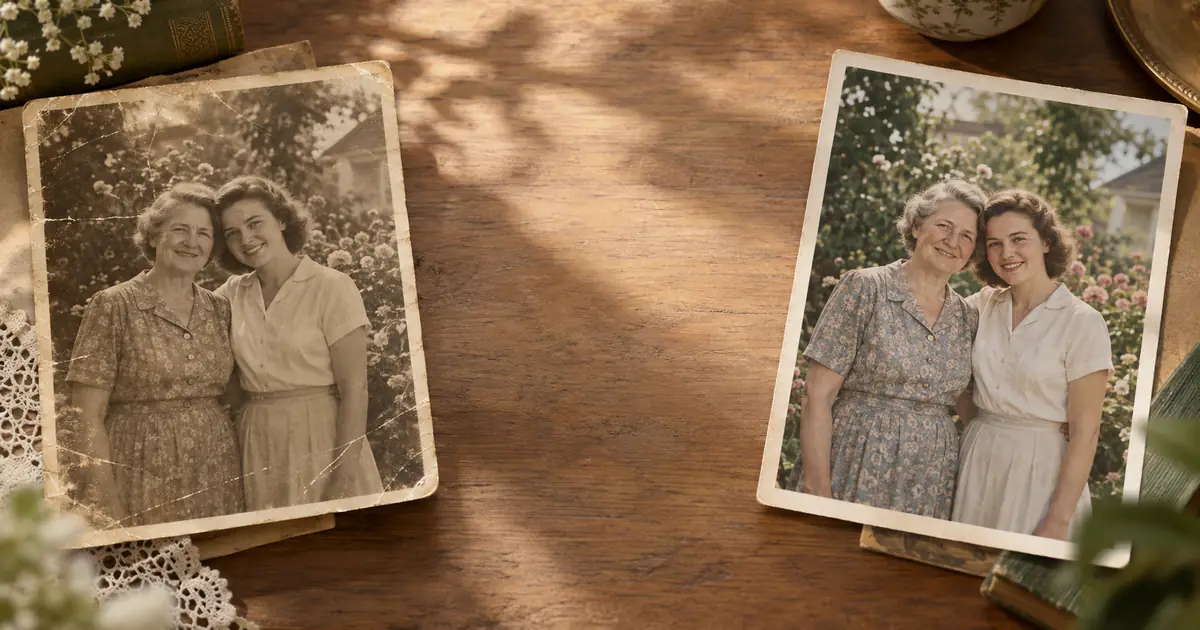
PicWish is built around background removal and basic enhancement. ArtImageHub runs a deep restoration pipeline for damaged old photos. Here is a direct comparison of features, face quality, colorization, file limits, and pricing.
ArtImageHub Editorial Team
PicWish and ArtImageHub are both AI-powered photo tools that appear in the same search results and occasionally in the same listicles. They are not the same kind of product. Understanding what each tool was built to do -- and what it was not built to do -- is the fastest path to choosing the right one for your photos.
What Is Each Tool Actually Designed For?
PicWish was built primarily as a background removal tool. Its core value proposition is the AI cutout: upload a product photo, portrait, or any image, and get the subject extracted from its background in seconds. The company has expanded from that core into basic AI enhancement features -- face retouching, sharpening, color adjustment -- but background removal remains the dominant use case and the product area receiving the most development investment. PicWish is popular with e-commerce sellers, social media content creators, and small business owners who need clean product shots quickly.
ArtImageHub was built specifically for restoring old and damaged photographs. The pipeline is purpose-assembled from models chosen for degradation recovery: Real-ESRGAN for upscaling and shadow detail recovery, GFPGAN for face restoration from aged and damaged portraits, DDColor for adding historically plausible color to black-and-white photographs, and NAFNet for denoising and deblurring scanned prints. The workflow is designed for family archive use: upload a faded, torn, or age-damaged photo and get a restored version without learning editing software.
These are different product categories that share a web-based AI photo tool interface. The comparison that matters is not which tool has more features overall, but which tool is better at the specific task you need.
How Do They Compare on Face Enhancement?
Face quality is often the deciding factor for old family photos where portraits are the primary subject.
PicWish's face retouching is designed for modern portrait enhancement: smoothing skin, brightening eyes, reducing blemishes. These operations assume a relatively high-quality input -- a clear, well-lit face from a modern digital photo or a clean print. On an aged 1950s portrait with yellowing, soft focus from lens limitations, and facial detail compressed into a narrow tonal range, PicWish's enhancement often produces a processed look without recovering the underlying facial structure.
ArtImageHub applies GFPGAN to every face in the uploaded photo. GFPGAN was trained specifically to recover high-frequency facial detail from degraded inputs -- it has a strong generative prior for human face structure that allows it to reconstruct eye texture, skin detail, and lip definition even when the source image provides only coarse facial geometry. On aged portraits, this produces the characteristic "sharper than it should be" restoration quality that family photo archive users report as one of the most valuable outputs.
For modern photos needing light retouching, PicWish's face enhancement is adequate. For 1940s through 1980s print photos with typical age degradation, GFPGAN's specialized training for old photo faces gives ArtImageHub a consistent advantage.
Does PicWish Offer Colorization?
PicWish does not currently offer AI black-and-white to color conversion as a standalone feature. The product's AI enhancement tools focus on quality improvement, background operations, and basic retouching rather than colorization.
ArtImageHub includes DDColor-powered colorization as part of its restoration pipeline. DDColor uses a dual-decoder architecture that produces naturalistic color for a wide range of black-and-white photographic subjects -- skin tones, foliage, sky, fabric, and architectural elements. For family photos shot before the color photography era, this colorization capability is often the feature that provides the most emotionally significant transformation.
If colorizing a black-and-white photo is the primary goal, PicWish is not the right tool. ArtImageHub's colorization pipeline is one of its core capabilities.
What Are the File Size and Format Limits?
PicWish accepts images up to 25 MB per file and supports JPEG, PNG, and WebP formats. For most photos, this is adequate. For very high-resolution scans -- 600 DPI scans of large format prints, for instance -- files can exceed this limit and require downsampling before upload.
ArtImageHub accepts uploads up to 20 MB and supports JPEG and PNG. For 35mm print scans at 600 DPI, typical file sizes fall within this range without requiring compression.
Both tools work with standard consumer scan outputs. For archival-quality high-DPI scans of large prints, file size limits are worth checking before starting a large restoration project.
How Do the Pricing Structures Compare?
PicWish uses a credit-based model. New users receive a small number of free credits (sufficient for a few operations) after which credits must be purchased in packs or through a subscription. The Pro subscription costs approximately $9.99 per month for unlimited background removals, with AI enhancement features available at higher tiers. For occasional users, the per-credit cost on individual purchases is higher than the monthly subscription rate.
ArtImageHub charges $9.90 one-time. There is no subscription, no credits, and no per-photo fee after the initial payment. The $9.90 unlocks unlimited high-resolution photo restorations -- you can restore an entire family album for the same cost as restoring a single photo. There is no free tier and no free preview -- payment is required before upload, so you view the restored result after paying, not before.
For a one-time family archive project, ArtImageHub's flat-fee model is substantially less expensive than PicWish's subscription. For ongoing e-commerce use where background removal is the primary need, PicWish's subscription makes more economic sense.
Which Tool Should You Use for Different Photo Types?
| Photo Type | Better Choice | Reason |
|---|---|---|
| Modern portrait, needs background removed | PicWish | Core capability, faster at this specific task |
| Old family portrait, 1940s-1980s | ArtImageHub | GFPGAN face restoration tuned for aged photos |
| Black-and-white photo needing color | ArtImageHub | DDColor colorization not available in PicWish |
| Faded, yellowed print | ArtImageHub | Full restoration pipeline vs. basic enhancement |
| Product photo for e-commerce | PicWish | Background removal is its primary strength |
| Torn or scratched old photo | ArtImageHub | Real-ESRGAN damage recovery pipeline |
| Group photo needing all faces sharpened | ArtImageHub | GFPGAN detects and restores multiple faces |
| Social media headshot, modern | PicWish | Face retouching designed for current photography |
What Is the Workflow Difference?
PicWish operates on a per-operation model: you choose a tool (background remover, face retouch, enhancer), upload, process, download. Different operations require separate processing passes and may draw from credits differently depending on the tier.
ArtImageHub runs the full restoration pipeline in a single pass: upscaling, face restoration, denoising, and (optionally) colorization all apply to the uploaded photo together. The $9.90 payment happens before upload, so there is no free preview — the result is ready in 60 to 90 seconds once processing starts.
For restoring old photos, the single-pass pipeline is faster and simpler. For creative operations on modern photos -- cutting subjects, trying different backgrounds -- PicWish's modular tool approach gives more control.
Frequently Asked Questions
Can PicWish restore old damaged photographs?
PicWish offers AI photo enhancement features including sharpening, color adjustment, and face retouching. These tools improve the quality of photos that are already in reasonable condition. PicWish is not optimized for the specific degradation patterns of old photographs: yellowing, fading, emulsion cracking, scratch damage, and the tonal compression of decades-old prints. Its face enhancement assumes a relatively clear input and does not apply the generative reconstruction that GFPGAN uses to recover facial detail from genuinely degraded portraits. For modern photos needing quality improvements, PicWish's enhancement is functional. For family archive photos from the 1940s through 1980s with typical age damage, ArtImageHub's purpose-built restoration pipeline consistently produces better results, particularly on faces that are the primary subject of most family portraits.
Is ArtImageHub a subscription service?
No. ArtImageHub charges a single one-time fee of $9.90, which unlocks unlimited high-resolution photo downloads with no time limit, no monthly billing, and no per-photo charge. This flat-fee model is different from most AI photo tools, which use either subscription pricing or per-credit pricing. The $9.90 payment covers as many photos as you need to restore, making it cost-effective for family archive projects that involve dozens or hundreds of photos. There is no free preview: the $9.90 payment is required before you can upload a photo, so you see the restored result only after paying, not before deciding.
Does ArtImageHub remove photo backgrounds like PicWish?
No. ArtImageHub does not include background removal as a feature. Its pipeline focuses on photo restoration: recovering detail and color in damaged, faded, or aged photographs. Real-ESRGAN handles upscaling and shadow recovery, GFPGAN restores facial detail, DDColor adds color to black-and-white photos, and NAFNet handles noise and blur reduction. Background replacement and subject isolation are not part of this pipeline. If you need background removal for a product photo or modern portrait, PicWish is better suited to that task. If you need old family photos restored, ArtImageHub is the specialized tool. The two products occupy different niches despite appearing in overlapping search results.
How does DDColor compare to PicWish's colorization feature?
PicWish does not currently offer a standalone black-and-white to color AI conversion feature. ArtImageHub's DDColor colorization uses a dual-decoder architecture designed to produce naturalistic, historically plausible color assignments for a wide range of photographic subjects. For family portraits from before the color photography era, DDColor assigns skin tones, fabric colors, and environmental colors based on learned associations from a large training set. The results are not perfectly accurate -- DDColor cannot know the actual color of a 1940s dress -- but they produce visually convincing and emotionally engaging colorized versions of B&W photos. For anyone whose primary goal is colorizing a black-and-white family photo, ArtImageHub is the more appropriate choice among these two tools.
Which tool handles multiple faces in a group photo better?
ArtImageHub's GFPGAN implementation detects and restores all faces in a photo individually, scaling the restoration to each face's size and clarity level in the image. A 1960s family reunion photo with a dozen faces at varying distances from the camera will receive restoration treatment on each detected face during a single processing pass. PicWish's face enhancement is primarily designed for single-subject portraits or close-up faces and does not apply the same level of specialized reconstruction to small or partially obscured faces in the background of a group shot. For family archive photos that are commonly group shots -- holiday gatherings, school photos, reunion portraits -- ArtImageHub's multi-face GFPGAN pipeline provides more consistent quality across all subjects in the image.
Ready to bring your own photos back to life? Try ArtImageHub's photo restoration tool — see what it can do with your own image.
Share this article
Ready to Restore Your Old Photos?
Try ArtImageHub's AI-powered photo restoration. Bring faded, damaged family photos back to life in seconds.